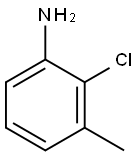
The chloromethylanilines are colorless or
white crystalline solids or liquids, some have a mild
fishy odor.
General procedure for the synthesis of 2-chloro-3-methylaniline (CAS: 29027-17-6) from 2-chloro-3-nitrotoluene: 2-chloro-1-methyl-3-nitrobenzene (1 eq.) was dissolved in acetic acid (0.5 M) followed by addition of iron powder (4 eq.). The reaction mixture was heated to reflux at 100 °C for 2 hours. After completion of the reaction, the solvent was removed by distillation under reduced pressure and methanol was added to the residue. The mixture was stirred at room temperature for 12 hours and then filtered. The filtrate was concentrated and purified by silica gel column chromatography to afford 2-chloro-3-methylaniline in 60% yield, the product was a red oil.1H NMR (400 MHz, DMSO-d6) δ ppm: 6.90 (t, J = 7.7 Hz, 1H), 6.66 (d, J = 7.9 Hz, 1H), 6.50 (d, J = 7.4 Hz, 1H). 5.23 (brs, 2H), 2.24 (s, 3H).
Most of the isomers are used in dyestuff manufacture. The 3-chloro-para isomer is used to kill
birds. It is marketed as pelleted bait for control of bird
populations.
UN2239 Chlorotoluidines, solid, Hazard Class:
6.1; Labels: 6.1-Poisonous materials. UN3429
Chlorotoluidines, liquid, Hazard Class: 6.1; Labels: 6.1-
Poisonous materials
Incompatible with oxidizers, strong
acids; chloroformates, and acid anhydrides, isocyanates,
aldehydes forming fire and explosive hazards.
[1] Organic Letters, 2014, vol. 16, # 17, p. 4420 - 4423
[2] Patent: US2016/96841, 2016, A1. Location in patent: Paragraph 0349
[3] Journal of the Chemical Society, 1901, vol. 79, p. 1128
[4] Journal of the Chemical Society, 1902, vol. 81, p. 1327,1347
[5] Recueil des Travaux Chimiques des Pays-Bas, 1913, vol. 32, p. 247