Ethyl cyanoformate can be used as a cyanide source for the cyanation of:
- Activated olefins in the presence of a titanium catalyst.
- Carbonyl compounds catalyzed by 4-dimethylaminopyridine (DMAP) to yield corresponding cyanohydrin carbonates under metal-free and solvent-free conditions.
- Aldehydes and 2,2,2-trifluoroacetophenone catalyzed by N-heterocyclic carbene (NHC) to yield corresponding cyanohydrins ethyl carbonates.
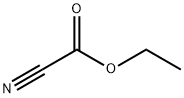
Ethyl Cyanoformate (cas# 623-49-4) is a compound useful in organic synthesis.
Ethyl cyanoformate is used as reagent in the preparation of N-substituted amindinoformic acid and ethyl-4-quinazoline -2-carboxylate.
Ethyl cyanoformate can be used as a cyanide source for the cyanation of:
Activated olefins in the presence of a titanium catalyst.
Carbonyl compounds catalyzed by 4-dimethylaminopyridine (DMAP) to yield corresponding cyanohydrin carbonates under metal-free and solvent-free conditions.
Aldehydes and 2,2,2-trifluoroacetophenone catalyzed by N-heterocyclic carbene (NHC) to yield corresponding cyanohydrins ethyl carbonates.
Ethyl cyanoformate is a general cyanating agent. It can be used in the nucleophilic addition of cyanide to carbonyl compounds, oxidative cyanation of tertiary amines and in the synthesis of β-cyano-substituted acrylates from alkynes.
Ethyl cyanoformate was synthesized in the following steps:
S1, clean the reactor, add 100KG S-1500 aromatic solvent in the reactor;
S2, add 695KG ethyl chloroformate and 175KG hydrocyanic acid in the drip kettle;
S3, add 30KG triethylamine catalyst and 20KG pure water to the reaction kettle, start the reaction kettle stirring and mixing for 15 minutes and then stop the reaction kettle;
S4, reduce the temperature in the reactor to 2 and then start the reactor, add ethyl chloroformate and hydrocyanic acid dropwise under low-speed stirring, and control the rate of dropwise acceleration so that the dropwise addition is completed within 2 hours;
S5, continue stirring for 30 minutes after the dropwise addition is completed to obtain the ethyl cyanocarbonate crude product, then transfer the cyanocarbonate crude product to a distillation tower to carry out atmospheric pressure distillation of the cyanocarbonate crude product to remove the fraction before 90 , to obtain the colorless fuming fraction at 115-116 , which is the ethyl cyanocarbonate pure product;
S6, the raw material is separated from ethyl cyanoformate by cyanidation reaction and distillation, and then it is washed by sodium hydroxide in split phase to recover the catalyst.
Dissolve the cyanoformate in Et2O, dry it over Na2SO4, filter, evaporate and distil it [Malachowsky et al. Chem Ber 70 1016 1937, Adickes et al. J Prakt Chem [2] 133 313 1932, Grundmann et al. Justus Liebigs Ann Chem 577 77 1952]. [Beilstein 2 IV 1862.]
Moisture sensitive. Keep the container tightly closed in a dry and well-ventilated place. Incompatible with strong acids, strong bases, strong oxidizing agents and strong reducing agents.