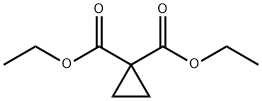
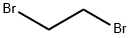
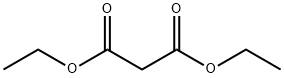
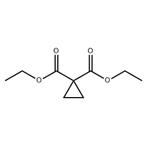
Step 1: Diethyl malonate (300 g, 1.87 mol) and 1,2-dibromoethane (634.5 g, 3.38 mol) were dissolved in DMSO (1.5 L) in a 5 L four-necked round bottom flask. To this solution was added K2CO3 (1020 g, 7.39 mol) and Bu4NBr (6.4 g, 19 mmol). The reaction mixture was stirred at room temperature for 48 hours. After completion of the reaction, the reaction was quenched by adding 2 L of water and extracted with EtOAc (1.5 L, 3 times). The organic phases were combined, dried with Na2SO4 and concentrated under reduced pressure. The residue was distilled under vacuum at 5-10 mmHg at 64-65°C to give diethyl cyclopropane-1,1-dicarboxylate 400 g (90% yield) as an oil.
If it is free from OH bands in the IR, then fractionally distil the ester and redistil the middle fraction. Otherwise shake it with aqueous NaHCO3, dry it (MgSO4), filter and distil as before or re-esterify it. [As synthon see Danishefsky Acc Chem Res 12 66 1979, Beilstein 9 I 314, 9 II 512, 9 III 3595, 9 IV 2786.]
[1] Tetrahedron, 2010, vol. 66, # 51, p. 9733 - 9737
[2] Tetrahedron Letters, 2005, vol. 46, # 4, p. 635 - 638
[3] Journal of Fluorine Chemistry, 2000, vol. 102, # 1-2, p. 141 - 146
[4] Mendeleev Communications, 2014, vol. 24, # 6, p. 345 - 345
[5] Journal of Organic Chemistry USSR (English Translation), 1983, vol. 19, p. 474 - 480