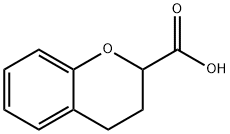
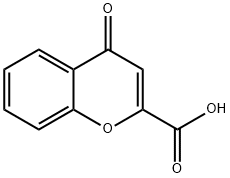
The general procedure for the synthesis of benzodihydropyran-2-carboxylic acid from 4-benzopyrone-2-carboxylic acid is as follows:
Example 20: Synthesis of (±)-benzodihydropyran-2-carboxylic acid
A mixture of the compound obtained in Example 19 (20.0 g, 105 mmol) and activated charcoal-loaded palladium (Pd 10%, 2.0 g) in acetic acid (200 mL) was subjected to a Parr hydrogenation unit and reacted under hydrogen pressure (60 psig). After 22.5 hours of reaction, the mixture was removed from the hydrogen atmosphere and filtered through a diatomaceous earth pad. The diatomaceous earth pad was washed with ethyl acetate (800 mL) and the filtrates were combined and concentrated to give a brown oil. The oil was dissolved in ethyl acetate (500 mL) and extracted with saturated aqueous NaHCO3 (4 x 125 mL). The aqueous phase was acidified with concentrated hydrochloric acid to pH=2 and extracted with ethyl acetate (4 x 100 mL). The organic phases were combined, washed with saturated aqueous sodium chloride solution (100 mL), dried over anhydrous magnesium sulfate and concentrated to give a colorless solid product (18.0 g, 96% yield). The melting point of the product was 97.5-99 °C; 1H NMR (DMSO-d6, 300 MHz) δ 12.96 (br s, 1H), 7.03 (m, 2H), 6.78 (m, 2H), 4.74 (dd, J = 6.4 Hz, 3.9 Hz, 1H), 2.73 (m, 1H), 2.63 (m, 1H), 2.03 (m, 2H ).