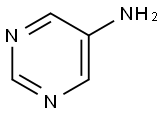
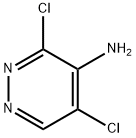
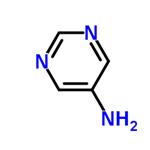
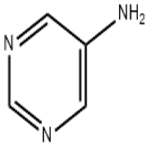
General procedure for the synthesis of 5-aminopyrimidines from 4-amino-3,5-dichloropyridazines: 5-amino-4,6-dichloropyridine (5.0 g, 30.5 mmol) was dissolved in 250 mL of diethyl ether, and sodium hydroxide solution (20.0 g, 0.50 mol, dissolved in 60 mL of water) and palladium-carbon catalyst (10% Pd/C, 400 mg) were sequentially added. The reaction mixture was placed in a Parr oscillator and the reaction was oscillated at room temperature under 50 psi hydrogen pressure for 20 hours. Upon completion of the reaction, the catalyst was removed by filtration through a CELITE filter aid. The organic and aqueous phases of the filtrate were separated and the aqueous phase was extracted with ethyl acetate (3 x 100 mL). The organic phases were combined, dried with magnesium sulfate, filtered and concentrated under reduced pressure. The crude product was recrystallized by ethyl acetate to give pyrimidin-5-ylamine (2.8 g, 95% yield) as a white crystalline solid.
The bromination of pyrimidin-5-ylamine was carried out under the same conditions as for the preparation of 4-amino-3-bromo-2,6-dimethylpyridine. The crude product obtained (300 mg, 35% yield) was tested to be of sufficient purity to be used directly in the subsequent reaction.
Steps for the alternative synthesis of 5-amino-4-bromopyrimidine: 4,6-dichloro-5-aminopyrimidine (21 g, 128 mmol) was dissolved in 250 mL of methanol, and ammonium formate (45 g, 714 mmol) and palladium-carbon catalyst (10% Pd/C, 1 g, 0.943 mmol) were added sequentially, and the reaction mixture was stirred at 0 °C overnight. Upon completion of the reaction, it was filtered through a CELITE filter aid and the filtrate was concentrated under reduced pressure to give a yellow solid. Water (100 mL) and ethyl acetate (250 mL) were added to separate the organic phase and the aqueous phase was extracted with ethyl acetate (8 x 250 mL). The organic phases were combined, dried with magnesium sulfate, filtered and concentrated under reduced pressure to give off-white crystals (8.1 g, 67% yield).
5-Aminopyridine (3.0 g, 31.5 mmol) was dissolved in a solvent mixture of dichloromethane (150 mL) and methanol (30 mL) and cooled to 0 °C. Benzyltrimethylammonium tribromide (13.5 g, 34.7 mmol) was added in batches over 10 minutes. The reaction mixture was continued to be stirred at 0 °C for 15 min and then brought to room temperature and stirred for 90 min. Upon completion of the reaction, the pH was adjusted with aqueous sodium bicarbonate to 8. The organic layer was separated and the aqueous layer was extracted with ethyl acetate (3 x 30 mL). The organic phases were combined, dried with sodium sulfate, filtered and concentrated under reduced pressure to give an off-white solid (2.8 g, 51% yield), which could be used without further purification.