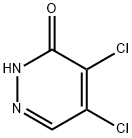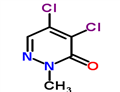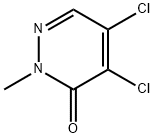
4,5-Dichloro-2-methylpyridazin-3-one
- Product Name4,5-Dichloro-2-methylpyridazin-3-one
- CAS933-76-6
- MFC5H4Cl2N2O
- MW179
- EINECS
- MOL File933-76-6.mol
Chemical Properties
| Melting point | 87-91 °C(lit.) |
| Boiling point | 197.2±50.0 °C(Predicted) |
| Density | 1.55±0.1 g/cm3(Predicted) |
| storage temp. | under inert gas (nitrogen or Argon) at 2-8°C |
| solubility | soluble in Ethanol |
| form | powder to crystal |
| pka | -3.57±0.20(Predicted) |
| color | White to Orange to Green |
| InChI | InChI=1S/C5H4Cl2N2O/c1-9-5(10)4(7)3(6)2-8-9/h2H,1H3 |
| InChIKey | ACKBTCUMGAHRIE-UHFFFAOYSA-N |
| SMILES | C1(=O)N(C)N=CC(Cl)=C1Cl |
Safety Information
| Hazard Codes | Xn |
| Risk Statements | 22-36/37/38-43 |
| Safety Statements | 26-36 |
| RIDADR | UN 2811 6.1/PG 3 |
| WGK Germany | 3 |
| RTECS | UR6188000 |
| HazardClass | 6.1 |
| HS Code | 29339980 |
| Storage Class | 6.1C - Combustible acute toxic Cat.3 toxic compounds or compounds which causing chronic effects |
| Hazard Classifications | Acute Tox. 3 Oral Eye Irrit. 2 Skin Irrit. 2 Skin Sens. 1 STOT SE 3 |