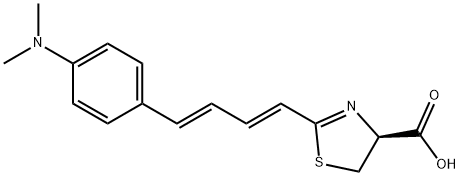
AkaLumine is a luciferin analogue. The bioluminescence produced by AkaLumine in reactions with native firefly luciferase is in the near-infrared wavelength ranges (λmax=677nm), and yields significantly increased target-detection sensitivity from deep tissues with maximal signals attained at very low concentrations, as compared with D-luciferin and emerging synthetic luciferin CycLuc1.
AkaLumine is a luciferin analogue. AkaLumine shows bioluminescence activity with FLuc. AkaLumine emits near-infrared (NIR) light with high tissue-penetration[1][2].
[1] MasahiroKiyama, et al. Quantum yield improvement of red-light-emitting firefly luciferin analogues for in vivo bioluminescence imaging. Tetrahedron 74 (2018) 652-660.
[2] Saito R, et al. Synthesis and luminescence properties of near-infrared N-heterocyclic luciferin analogues for in vivo optical imaging. Bulletin of the Chemical Society of Japan, 2019, 92(3): 608-618.