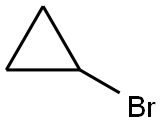
Cyclopropyl bromide is also named as Bromocyclopropane. It is used in organic synthesis, for instance, for the formation of a Grignard Reagent, cyclopropyllithium. It is also used as an intermediate in the manufacture of pharmaceutical and agrochemical products.
Light yellow to clear colourless liquid, boiling point 67-69°C, refractive index (nD20) 1.4605, density (d420) 1.5120, flash point -6°C.
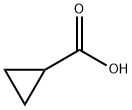
Bromocyclopropane has been prepared by the Hunsdiecker reaction by adding silver cyclopropanecarboxylate to bromine in dichlorodifluoromethane at 29° (53% yield) or in tetrachloroethane at 20° to 25° (15–20% yield). Decomposition of the peroxide of cyclopropanecarboxylic acid in the presence of carbon tetrabromide gave bromocyclopropane in 43% yield. An attempt to prepare the bromide via the von Braun reaction was unsuccessful. Ten percent yields are reported for the photobromination of cyclopropane and the photochemical rearrangement of allyl bromide. Treatment of 1,1,3-tribromopropane with methyllithium prepared from methyl bromide furnishes a 60–65% yield of bromocyclopropane.
Bromocyclopropane have anti-angiogenic effects that inhibits the growth of new blood vessels by interfering with the production of prostaglandins and nitric oxide, which are important for the formation of new blood vessels. Bromocyclopropane binds to cyclopropyl and hydrochloric acid, forming a hydrogen bond. It also forms a hydrogen bond with fatty acids and an a-type hydroxyl group.
(1) 179 g of 1,3-bromochloropropane was added to a three-necked flask, 29 g of potassium cyanide and 50 ml of water were added and heated and stirred until completely dissolved. Subsequently, 70 ml of ethanol solution was added and the mixture was stirred and refluxed for 2 hours. After completion of the reaction, it was cooled to room temperature and diluted with 300 ml of water to separate the oil and aqueous phases. The aqueous phase was extracted with 40 ml of chloroform, the organic phases were combined and dried with anhydrous calcium chloride. 316.9 g of hydrogen chloride was obtained. Chlorobutanenitrile 241.6 g was prepared by adding 100 ml of sodium hydroxide solution and stirring the reaction for 2 hours. Then 200 ml of water was added, cooled to about 10°C, 44 ml of concentrated sulfuric acid was added to acidify the reaction mixture, extracted with petroleum ether as an extractant, the organic phases were combined and dried with anhydrous sodium sulfate to obtain 330.1 g of cyclopropionic acid. (2) 324.8 g of cyclopropionic acid was added dropwise to a reaction flask with 48 g of mercuric oxide, 160 ml of a mixture of 1,1,2,2-tetrachloroethane and 64.4 g of liquid bromine, and stirred for 2 hours. After completion of the reaction, the mixture was cooled to 5°C, washed with tetrachloroethane and then dried with calcium chloride to give 419.15 g of bromocyclopropane.
Science of Synthesis: Houben-Weyl Methods of Molecular Transformation Vol. 7: Compounds of Group 13 and 2 (Al, Ga, In, Tl, Be…Ba), 2007, ISBN: 9783131484819
D. Seyferth, H. M. Cohen, The Stability of Cyclopropyllithium in diethyl ether and in tetrahydrofuran, Journal of Organometallic Chemistry, 1963, vol. 1, pp. 15-21
“Formal Nucleophilic Substitution of Bromocyclopropanes with Azoles”, Ryabchuk, P.; Rubina, M.; Xu, J.; Rubin, M. Org. Lett. 2012, 14, 1752.
“Formal Substitution of Bromocyclopropanes with Nitrogen Nucleophiles”, Banning, J. E.; Gentillon, J.; Ryabchuk, P. G.; Prosser, A. R.; Rogers, A.; Edwards, A.; Holtzen, A.; Babkov, I.; Rubina, M.; Rubin, M. J. Org. Chem., 2013, 78, 7601.