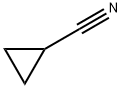
Cyclopropane-1-carboximidamide hydrochloride
- Product NameCyclopropane-1-carboximidamide hydrochloride
- CAS57297-29-7
- MFC4H9ClN2
- MW120.58
- EINECS611-495-3
- MOL File57297-29-7.mol
Chemical Properties
| Melting point | 123 °C |
| storage temp. | Inert atmosphere,Room Temperature |
| Water Solubility | Soluble in water |
| form | powder to crystal |
| color | White to Almost white |
| Sensitive | Hygroscopic |
| BRN | 4507255 |
| InChI | InChI=1S/C4H8N2.ClH/c5-4(6)3-1-2-3;/h3H,1-2H2,(H3,5,6);1H |
| InChIKey | JRYOZJIRAVZGMV-UHFFFAOYSA-N |
| SMILES | C1(C(N)=N)CC1.[H]Cl |
| CAS DataBase Reference | 57297-29-7(CAS DataBase Reference) |
Safety Information
| Hazard Codes | Xi |
| Risk Statements | 36/37/38 |
| Safety Statements | 26-36/37/39-37/39 |
| WGK Germany | 3 |
| Hazard Note | Irritant/Hygroscopic |
| HazardClass | IRRITANT |
| HS Code | 29252900 |
| Storage Class | 11 - Combustible Solids |
| Hazard Classifications | Eye Irrit. 2 Skin Irrit. 2 STOT SE 3 |