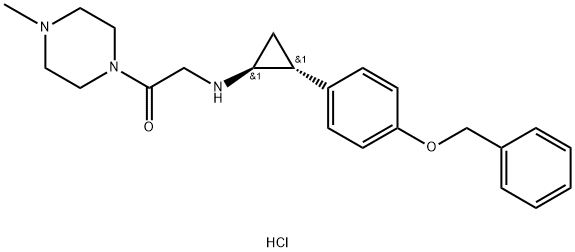
RN-1 Hydrochloride is a potent, irreversible inhibitor of LSD1. It blocks long-term but not short-term memory in mice following intraperitoneal administration. RN-1 also induces cytotoxicity in ovarian cancer cell lines and induces fetal hemoglobin synthesis while reducing disease pathology in sickle cell mice.
rn-1 (hydrochloride) is a brain-penetrant, potent and irreversible lsd1 inhibitor with ic50 values of 10-70 nm [1].lysine-specific demethylase 1 (lsd1) is a flavin-dependent monoamine oxidase that demethylate mono- and di-methylated lysines, specifically histone 3, lysines 4 and 9 (h3k4 and h3k9) [2].rn-1 (hydrochloride) is a potent and irreversible lsd1 inhibitor with ic50 values of 10-70 nm. however, rn-1 is much less effective against mao-a and mao-b with ic50 values of 0.51 and 2.785 μm, respectively [1]. in ovarian cancer lines, rn-1 also induced cytotoxicity, which was correlated with the lsd1 inhibitory potential [3].following intraperitoneal administration in mice, rn-1 penetrated the blood-brain barrier and the brain/plasma exposure ratio was 88.9. in mice, rn-1 significantly impaired long-term memory but not short-term memory. and long-term memory impairment was due to a brain-specific effect [1]. in a sickle cell disease (scd) mouse model, rn-1 induced hbf synthesis and increased frequencies of hbf-positive cells and mature erythrocytes, as well as reduced reticulocytes and sickle cells. and the rn-1 treated mice did not exhibit the necrotic lesions in the liver and spleen [4].
RN-1 (3-10 mg/kg; i.p.; daily; for 2 or 4 consecutive weeks) dihydrochloride effectively induces fetal hemoglobin (HbF) levels in red blood cells and reduces disease pathology in SCD mice[2].
In C57BL/6 male mice, after intraperitoneal administration of RN-1 dihydrochloride (10 mg/kg), concentrations are detectable up to 24 h post dose in both plasma and brain tissues. The brain/plasma exposure ratio is 88.9. RN-1 dihydrochloride significantly impairs long-term memory, but not short-term memory[1].
| Animal Model: | Sickle cell disease (SCD) mice[2] |
| Dosage: | 3 mg/kg or 10 mg/kg |
| Administration: | i.p.; daily; for 2 or 4 consecutive weeks |
| Result: | Effectively induced HbF levels in red blood cells and reduced disease pathology in SCD mice. |
[1]. neelamegam r, ricq el, malvaez m, et al. brain-penetrant lsd1 inhibitors can block memory consolidation. acs chem neurosci. 2012 feb 15;3(2):120-128.
[2]. shi y, lan f, matson c, et al. histone demethylation mediated by the nuclear amine oxidase homolog lsd1. cell. 2004 dec 29;119(7):941-53.
[3]. konovalov s, garcia-bassets i. analysis of the levels of lysine-specific demethylase 1 (lsd1) mrna in human ovarian tumors and the effects of chemical lsd1 inhibitors in ovarian cancer cell lines. j ovarian res. 2013 oct 29;6(1):75.
[4]. cui s, lim kc, shi l, et al. the lsd1 inhibitor rn-1 induces fetal hemoglobin synthesis and reduces disease pathology in sickle cell mice. blood. 2015 jul 16;126(3):386-96.