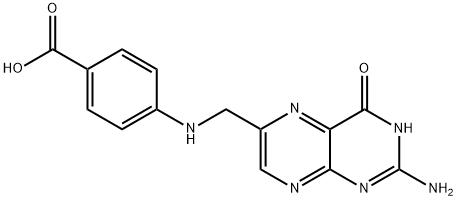
Pteroic Acid (Methotrexate EP Impurity D N-Desmethyl Impurity) is a constituent as well as a degradation product of Folic Acid (F680300) formed via enzymatic hydrolysis. has been shown to activate the glutamylation of methotrexate by folylpolyglutamate synthetase.
Pteroic Acid is a constituent as well as a degradation product of Folid Acid (F680300) formed via anzymatic hydrolysis. has been shown to activate the glutamylation of methotrexate by folylpolyglutama
te synthetase.
ChEBI: 4-{[(2-amino-4-hydroxypteridin-6-yl)methyl]amino}benzoic acid is a pteroic acid. It is functionally related to a 2-aminopteridin-4-ol. It is a conjugate base of a 2-amino-6-{[(4-carboxyphenyl)amino]methyl}-4-hydroxypteridin-1-ium. It is a conjugate acid of a 4-{[(2-amino-4-hydroxypteridin-6-yl)methyl]amino}benzoate. It is a tautomer of a 4-{[(2-amino-4-oxo-3,4-dihydropteridin-6-yl)methyl]amino}benzoic acid and a 4-{[(2-amino-4-oxo-1,4-dihydropteridin-6-yl)methyl]amino}benzoic acid.
Folic Acid Impurity D is an impurity of the water-soluble B-vitamin, folic acid. Folic Acid is generally used in the treatment of certain types of anemia.
Pharmaceutical secondary standards for application in quality control, provide pharma laboratories and manufacturers with a convenient and cost-effective alternative to the preparation of in-house working standards.
Pteroic acid can be prepared by a variety of conventional methods, said methods including synthesis, microbial degradation of folic acid, enzymatic degradation of folic acid, hydrolysis of folic acid and other conventional methods. Generally, pteroic acid prepared by these methods can often be contaminated with significant amounts of folic acid. For example, pterionic acid prepared by enzymatic degradation may contain 25% folic acid. Thus, effective methods are needed to remove folic acid contaminants as well as other impurities originating from the preparation of pteroic acid. Vitamin-drug concoctions, including concoctions of pteroic acid, may be prepared using synthetic methods. In some cases, those synthetic methods can also result in the formation of by-products, impurities, or other contaminants.
This metabolite (FWfree-acid = 312.29 g/mol; CAS 119-24-4), also known as 4-[[(2-amino-1,4-dihydro-4-oxo-6-pteridinyl)methyl]amino]benzoic acid, is a structural component of folates. Pteroic acid is a growth factor for a number of Enterococci. Pteroic acid is a yellow powder that is slightly soluble in aqueous NaOH. The lmax values in 0.1 M NaOH are 255, 275, and 365 nm (e = 26300, 23400, and 8900 M–1cm–1, respectively). Target(s): arylamine N-acetyltransferase; dihydrofolate reductase; dihydrofolate synthetase, weakly inhibited; dihydropteroate synthase; glutamate carboxypeptidase; and xanthine oxidase.
Crystallise it from dilute HCl. Dry it in vacuo. Hygroscopic IRRITANT. [Nair et al. J Org Chem 46 3152 1981, Beilstein 26 III/IV 3942.]