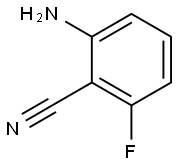
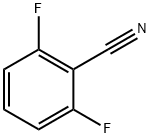
1. 2,6-Difluorobenzonitrile (19.0 g, 137 mmol) was used as raw material, which was mixed with ethanol (200 ml) premixed with ammonia and placed in an autoclave and heated at 140°C for 6 hours (final pressure 200 psi). After completion of the reaction, the mixture was cooled to room temperature, evaporated to dryness and ground with 200 ml of water. The solid was collected by filtration and air dried to give 2-amino-6-fluorobenzonitrile (18.0 g, 97%) as an off-white solid.
2. 2-Amino-6-fluorobenzonitrile (18.0 g, 132 mmol) was dissolved in hot 1,4-dioxane (20 ml), 48% hydrobromic acid (200 ml) was added, and the mixture was cooled to 0 °C. An aqueous solution of sodium nitrite (10.5 g, 152 mmol) was added dropwise (20 ml) over 1.5 hours. After stirring at 0°C for 1.5 hours, the mixture was poured into a 48% hydrobromic acid solution (50 ml) of copper (I) bromide (56.8 g, 396 mmol) pre-cooled to 0°C. It was stirred at 0°C for 15 min and then heated at 50°C for 20 min. After cooling to room temperature, it was diluted with water (1200 ml) and extracted with ethyl acetate (2 x 400 ml). The organic phases were combined, washed sequentially with 10% ammonia solution (400 ml), water (400 ml) and brine (500 ml), dried over anhydrous magnesium sulfate, filtered and evaporated to give an orange oil. Purification by silica gel chromatography using isohexane-ethyl acetate (2-4%) gradient elution gave 2-bromo-6-fluorobenzonitrile (18.5 g, 70%) as a white solid.
3. coupling 2-bromo-6-fluorobenzonitrile with 2-(2-fluoro-5-nitrophenyl)-4,4,5,5-tetramethyl-[1,3,2]dioxaborolane according to the method of Example 2 to obtain 3,2'-difluoro-5'-nitrobiphenyl-2-carbonitrile as a black solid.
4. 3,2'-Difluoro-5'-nitrobiphenyl-2-carbonitrile was reduced according to the method of Example 2 to obtain 5'-amino-3,2'-difluorobiphenyl-2-carbonitrile as a brown solid.
5. 5'-Amino-3,2'-difluorobiphenyl-2-carbonitrile was subjected to a bromination-deamination reaction according to the method of Example 2 to obtain 5'-bromo-3,2'-difluorobiphenyl-2-carbonitrile as a white solid.
6. 5'-Bromo-3,2'-difluorobiphenyl-2-carbonitrile was converted to 3,2'-difluoro-5'-(5,5-dimethyl-[1,3,2]dioxaborolan-2-yl)biphenyl-2-carbonitrile according to the method of Example 2, as a brown oil, which crystallized upon standing.
7. 3-bromo-8-fluoro-7-[(1-hydroxy-1-methylethyl)]imidazo[1,2-a]pyridine (0.10 g, 0.36 mmol) was coupled with 3,2'-difluoro-5'-(5,5-dimethyl-[1,3,2]dioxaborolan-2- yl)biphenyl-2-carbonitrile (0.16 g, 0.47 mmol) according to the method of Example 1 Coupling was performed to afford 3,2'-difluoro-5'-[8-fluoro-7-(1-hydroxy-1-methylethyl)imidazo[1,2-a]pyridin-3-yl]biphenyl-2-carbonitrile as a white amorphous solid (110 mg, 74%).