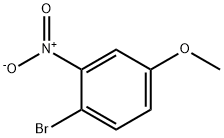
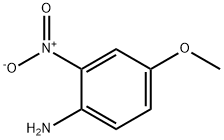
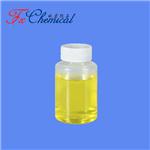
The general procedure for the synthesis of 4-bromo-3-nitroanisole from ice-dyed diazo component 1 was as follows: a solution of sodium nitrite (11.8 g) in water (28 mL) was slowly added dropwise to a 40% solution of nitroaniline (125 mmol) in hydrobromic acid (110 g) over a period of 0.5 h. The temperature of the reaction was maintained at 10 °C. The reaction mixture was stirred at 0-10 °C for 40 min and then filtered. Subsequently, the filtrate was added dropwise to a purple solution of copper(I) bromide (209 mmol) in hydrobromic acid (74 mL) at 0 °C over a period of 1 hour. The reaction mixture was gradually warmed to room temperature and held for 30 min, then warmed to 60 °C for 0.5 h. The reaction was finally heated and refluxed for 1 h. The reaction was carried out at a temperature of 0.5 °F to 0.5 °F. After completion of the reaction, the mixture was partitioned between water (2.0 L) and dichloromethane (600 mL) and the aqueous phase was then extracted with dichloromethane (300 mL). All organic layers were combined and washed sequentially with 10% sodium hydroxide solution (200 mL), water (600 mL), 10% hydrochloric acid (300 mL) and water (600 mL). The organic layer was dried over magnesium sulfate and concentrated to give 4-bromo-3-nitroanisole in 83% yield as a yellow oil.
[1] Journal of Organic Chemistry, 1989, vol. 54, # 25, p. 5856 - 5866
[2] Journal of Organic Chemistry, 1992, vol. 57, # 24, p. 6380 - 6382
[3] Journal of the American Chemical Society, 1994, vol. 116, # 26, p. 11797 - 11810
[4] Tetrahedron Letters, 2006, vol. 47, # 16, p. 2739 - 2742
[5] Tetrahedron, 2010, vol. 66, # 37, p. 7418 - 7422