Beige to brownish crystalline powder
Quinazoline was used to study the electrochemical behaviour of quinazoline using modern polarographic and voltammetric methods. It is the basic structural unit of pharmaceuticals and plays an important role in modern synthesis of antitumor drugs.
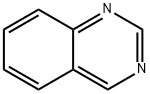
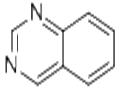
ChEBI: A mancude organic heterobicyclic parent that is naphthalene in which the carbon atoms at positions 1 and 3 have been replaced by nitrogen atoms.
Quinazolines has applications in medicinal chemistry due to their antibacterial, antifungal, anticonvulsant, anti-inflammatory and antitumor activities. It is the basic structural unit of pharmaceuticals and plays an important role in modern synthesis of antitumor drugs.
Genotoxicity of quinazoline was established by bacterial SOS Chromotest (Escherichia Coli).
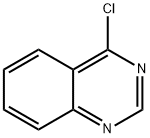
The general method for the synthesis of quinazoline from 4-chloroquinazoline was as follows: first, the halogenated heterocycle (0.66 mmol) was dissolved in anhydrous THF (13.2 mL) and degassed by drumming argon gas for several minutes. Subsequently, PdCl2 (dppf) (27.0 mg, 0.033 mmol, 5.0 mol%), TMEDA (0.130 g, 1.12 mmol, 1.7 equiv), and NaBH4 (42.4 mg, 1.12 mmol, 1.7 equiv) were added sequentially. The reaction mixture was stirred at room temperature for an appropriate time under argon protection, after which it was post-treated according to standard methods.
Purify quinazoline by passage through an activated alumina column in *C6H6 or pet ether (b 40-60o). Distil it under reduced pressure, sublime it under vacuum and crystallise it from pet ether. The picrate has m 188-189o (from MeOH). [Armarego J Appl Chem 11 70 1961, Armarego Quinazolines, Fused Pyrimidines Part I Brown Ed, Wiley-Interscience 1967, Brown Quinazolines Supplement I Taylor Ed, Wiley-Interscience 1996, ISBN 0-471-14565-3; for covalent hydration see Albert & Armarego Adv Heterocycl Chem 4 1 1965, Beilstein 23 H 175, 23 II 177, 23 III/IV 1221.]
[1] Journal of Molecular Catalysis A: Chemical, 2014, vol. 393, p. 191 - 209