Oily, amber liquid. Odorless. Flammable.
Commercial product is available as an emulsifiable concen-
trate.
Food additive; herbicide.
ChEBI: Sethoxydim is an organic hydroxy compound.
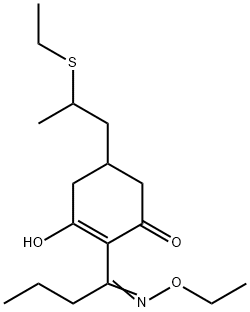
The production of sethoxydim involves a multi-step synthesis process typical of cyclohexanedione herbicides. It begins with the construction of a substituted cyclohexenone ring, followed by the introduction of key functional groups: a hydroxy group at position 3, an ethylthio-propyl side chain at position 5, and an ethoxyimino-butyl moiety at position 2. These steps require controlled reactions involving alkylation, oxime formation, and thiolation, often using organic solvents such as toluene or xylene.
Oily odorless liquid. Non corrosive. Used as an herbicide.
A cyclohexene, oxime derivative. Sethoxydim is incompatible with organic and inorganic copper compounds.
Herbicide: A selective post-emergence herbicide used to control annual and perennial grass weeds in broad-leaved vegetables, field crops, fruit, ornamentals and indoor applications. Not approved for use in EU countries. Registered for use in the U.S. and Canada.
ALJADEN®; ALLOXOL® S; ARD 34/02®; BASF 9052®; CHECKMATE®; CONCLUDE®; EXPAND®; FERVINAL®; GRASIDIM®; GRASSOUT®; NABU®; NP-55®; POAST®; TRITEXEXTRA®; ULTIMA®; VANTAGE®
Selective, systemic absorbed mainly by foliage. Acetyl CoA carboxylase inhibitor (ACCase) - distrupts fatty acid biosynthesis and lipid formation.
A selective postemergence cyclohexa-
dione/cyclohexenone herbicide used to control both annual
and perennial grass weeds in broad-leaved vegetables, field
crops, fruit, ornamentals, and indoor applications.
UN3082 Environmentally hazardous substances,
liquid, n.o.s., Hazard class: 9; Labels: 9-Miscellaneous haz-
ardous material, Technical Name Required
Incompatible with strong acids, oxidizers
(chlorates, nitrates, peroxides, permanganates, perchlorates,
chlorine, bromine, fluorine, etc.). Incompatible with oxidi-
zers (chlorates, nitrates, peroxides, permanganates, perchlo-
rates, chlorine, bromine, fluorine, etc.); contact may cause
fires or explosions. Keep away from alkaline materials, strong bases, strong acids, oxoacids, epoxides.
Incompatible with all copper compounds.
It is the responsibility of
chemical waste generators to determine the toxicity and physical properties and of a discarded chemical and to
properly identify its classification and certification as a haz-
ardous waste and to determine the disposal method. United
States Environmental Protection Agency guidelines for the
classification determination are listed in 40 CFR Parts
261.3. In addition, waste generators must consult and fol-
low all regional, national, state, and local hazardous waste
laws to ensure complete and accurate classification and dis-
posal methods. Follow recommendations for the disposal of
pesticides and pesticide containers. Containers must be dis-
posed of properly by following package label directions or
by contacting your local or federal environmental control
agency, or by contacting your regional EPA office.