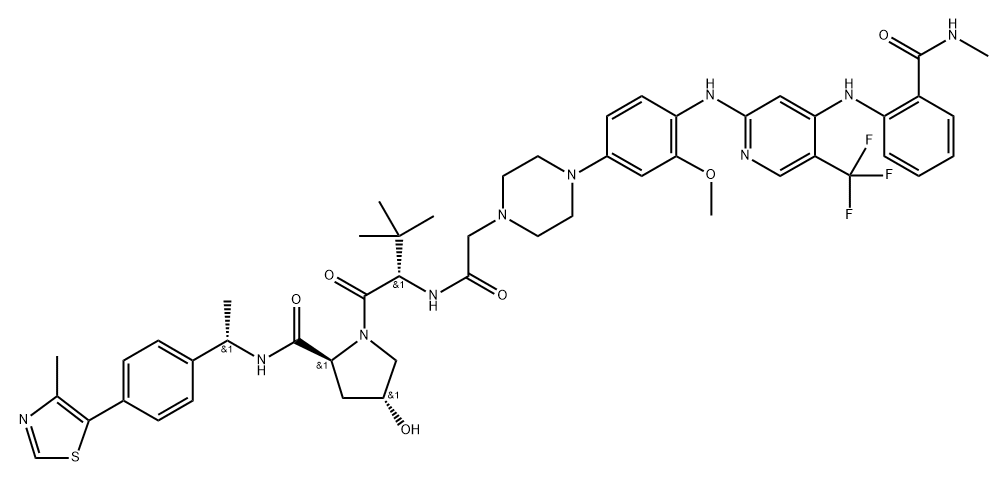
GSK215 is a potent and selective PROTAC focal adhesion kinase (FAK) degrader with a pDC50 of 8.4. GSK215 is designed by a binder for the VHL E3 ligase and the FAK inhibitor VS-4718. GSK215 induces rapid and prolonged FAK degradation, giving a long-lasting effect on FAK levels and a marked pharmacokinetic/pharmacodynamics (PK/PD) disconnect[1].
GSK215 is a potent and selective PROTAC focal adhesion kinase (FAK) degrader. GSK215 is designed by a binder for the VHL E3 ligase and the FAK inhibitor VS-4718. GSK215 induces rapid and prolonged FAK degradation, giving a long-lasting effect on FAK levels and a marked pharmacokinetic/pharmacodynamics (PK/PD) disconnect[1].
GSK215 (0.1-1000 nM; 2 hours) effectively increases the FAK degradation by >90% and determines a DC50 of 1.3 nM[1].
GSK215 (8mg/kg; i.h.) treatment shows the Cmax and tmax values of 526 ng/mL and 0.33 hours, respectively[1].
GSK215 (0.1-1000 nM; 2 h) effectively increases the FAK degradation by >90% and determines a DC50 of 1.3 nM in A549 cells. Its induced degradation is proteasome and ubiquitin-dependent. GSK215 (above 100 nM, 6h) primarily reduces kinases CDK7, RPS6KA3, MET, and GAK. This compound (100 nM, 48 h) inhibits migration, invasion, and collagen deposition in A549 cells.
GSK215 (8 mg/kg; i.h.; once) degrades FAK, and shows the Cmax and tmax values of 526 ng/mL and 0.33 hours, respectively[1].
| Animal Model: | Male CD1 mice (P878/881A), 7-9 weeks[1] |
| Dosage: | 8 mg/kg |
| Administration: | Single subcutaneous injection |
| Result: | Caused a rapid and profound degradation of FAK in liver over time, with a maximal degradation of ~85% being achieved within 18 h. Endogenous FAK was found to still be reduced by ~60% at 96 h post-dose.The Cmax and tmax were 526 ng/mL and 0.33 hours, respectively.
|
[1]. Law RP, Nunes J, Chung CW, et al. Discovery and Characterisation of Highly Cooperative FAK-Degrading PROTACs [published online ahead of print, 2021 Aug 20]. Angew Chem Int Ed Engl. 2021;10.1002/anie.202109237.