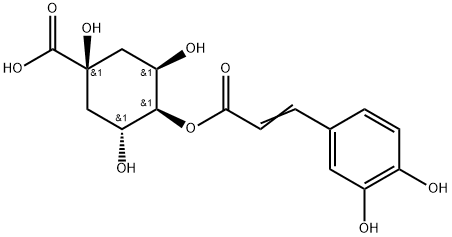
White needle-shaped crystals, soluble in organic solvents such as methanol, ethanol, and DMSO, derived from Eucommia ulmoides, Lonicera japonica, and Honeysuckle.
Cryptochlorogenic acid may be used as a reference standard in the determination of cryptochlorogenic acid in the leaves of Hibiscus sabdariffa using high performance liquid chromatography coupled with mass spectrometry (HPLC-MS).
4-O-Caffeoylquinic acid has been used as a reference compound for the quantification in high performance liquid chromatography-diode array detector (HPLC-DAD).
ChEBI: A cinnamate ester obtained by formal condensation of the carboxy group of trans-caffeic acid with the 4-hydroxy group of (+)-quinic acid.
Cryptochlorogenic acid is a polyphenol, found in a variety of plants, which plays a crucial role in protection against various age-related diseases.
4-O-Caffeoylquinic acid (4-CQA) is a major active antioxidant marker in mulberry leaf extract. It is an inhibitor of ferroptosis hence, it is recognized as a potent anti-diabetic agent. 4-CQA plays an important role in the upregulation of nuclear factor (erythroid-derived 2)-like 2 (Nrf2) pathway.
Pharmacokinetic parameters of Cryptochlorogenic acid after intragastric administration of Cryptochlorogenic acid at three dosages[2]
| Dose (mg/kg) | Cmax (μg/L) | tmax (h) | t1/2 (h) | AUC0-t (μgh/L) | AUC0-∞ (μgh/L) | MRT0-t (h) | MRT0-∞ (h) |
| 100 | 630 | 0.33 | 2.00 | 1938.91 | 1977.70 | 3.21 | 3.51 |
| 200 | 1270.09 | 0.47 | 1.97 | 3071.87 | 3179.41 | 3.23 | 3.39 |
| 400 | 2582.68 | 0.44 | 2.34 | 8825.32 | 9139.54 | 3.47 | 3.93 |