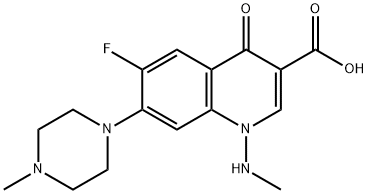
Amifloxacin (WIN 49375) is highly active by the oral route, with 50% effective doses within two- to threefold of those obtained with parenteral medication. The effectiveness of Amifloxacin with various routes of medication is demonstrated with these experimental infections. When mice infected intraperitoneally with E. coli Vogel are medicated at 0.5-h postinfection subcutaneously, intravenously, or orally the ED50s for Amifloxacin are 0.6, 0.8, and 1.0 mg/kg, respectively[1]. Blood radioactivity peaks at 0.5 h after oral administration of [14C]Amifloxacin mesylate to rats at 20 mg/kg and is equivalent to 7.1±0.26 μg of Amifloxacin per mL. From 0.75 to 4 h, blood radioactivity decreases rapidly from 7.0±0.25 μg/mL to 1.2±0.12 μg/mL. Between 8 and 48 h the rate of decline in blood radioactivity slows and is more complex. At 48 h, the blood radioactivity is equivalent to 0.14±0.02 μg/mL. Blood levels of radioactivity after i.v. administration of [14C]Amifloxacin mesylate to rats at 20 mg/kg decrease from 29.1±0.85 μg/mL at 1.0 min to 14.4±0.52 μg/mL at 10 min. From 0.25 to 4 h blood radioactivity decreases from 13.0±0.42 μg/mL to 0.97±0.09 μg/mL in a log-linear manner. The rate of elimination from 4 to 24 h is slower and more complex. At 24 h, blood radioactivity is equivalent to 0.12±0.01 ug/mL[2].