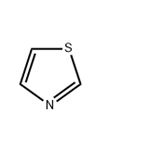
colourless or pale yellow liquid with a disgusting smell
Thiazole has a green, sweet, nutty, tomato note.
Reported found in roasted chicken, chicken fat, boiled and cooked beef, grilled and roasted beef, pork liver, beer, cognac and other types of grape brandy, rum, coffee, roasted barley, roasted filbert, roasted peanut, soybean, popcorn, oat products, rice bran, buckwheat, malt, wort, dried bonito, crab, crayfish, Chinese quince and other natural sources.
Organic synthesis of fungicides, dyes, and rubber
accelerators.
Thiazoles were used to create novel recognition motifs for interaction with divalent and trivalent metal ions in siderophores or antibiotics.
Thiazole is used as a flavoring agent and in the preparation of dyes and rubber accelerators. It serves as a component of the vitamin thiamine (B1). It acts as a protected formyl group used in natural product synthesis. It reacts with alkyl lithium and Grignards reagent to prepare organometallic complexes. It is involved in the electrophilic aromatic substitution and nucleophilic aromatic substitution at C-5 and C-2 positions respectively. Further, it undergoes alkylation reaction to get thiazolium cation, which is used as a catalyst in the Stetter reaction and the Benzoin condensation. In addition to this, it is involved in the preparation of alagebrium.
The generation of thiazole derivatives by means of condensation of α-haloketones and thioamidesis referred to as the Hantzsch thiazole synthesis. This reaction takes place due to the strong nucleophilicity of the sulfur atom in thioamides or thioureas, and gives fantabulous yields for simple thiazoles but low yields for some substituted thiazoles, as of dehalogenation. It is a multistep reaction, and the intermediates have been isolated at low temperatures. This reaction has been changed to reduce the epimerization upon the formation of thiazole. Additionally, α-tosyloxy ketones have been used to replace α-haloketones for such reactions. It has wide application in the preparation of thiazole derivatives.
A colorless volatile liquid, a beterocyclic compound with a five-membered ring
containing three carbon atoms, one nitrogen atom, and one sulfur atom. It resembles PYRIDINE in its reactions.
thiazole: A heterocyclic compound containing a five-membered ringwith sulphur and nitrogen heteroatoms, C3SNH3. A range of thiazoledyes are manufactured containingthis ring system.
Colorless or pale yellow liquid with a foul odor.
Thioisocyanates, such as Thiazole, are incompatible with many classes of compounds, reacting exothermically to release toxic gases. Reactions with amines, aldehydes, alcohols, alkali metals, ketones, mercaptans, strong oxidizers, hydrides, phenols, and peroxides can cause vigorous releases of heat.