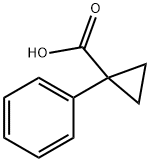
The general procedure for the synthesis of 1-phenylcyclopropanamine hydrochloride from 1-phenyl-1-cyclopropanecarboxylic acid is as follows: first, 1-phenylcyclopropanecarboxylic acid (1) was reacted with sodium azide and sulfuric acid in chloroform to produce 1-phenylcyclopropanamine (2). Subsequently, 1-phenylcyclopropanamine was reacted with 2-methanesulfonyl chloride in chloroform under alkaline conditions to prepare to obtain the protected derivative (3), i.e., N-(1-phenylcyclopropyl) homotrimethylbenzenesulfonamide. Next, N-(1-phenylcyclopropyl)homotrimethylbenzenesulfonamide (3) was reacted with N-(4-bromobutyl)phthalimide (4) in DMF in the presence of sodium hydride overnight at room temperature to obtain N-(2- homotrimethylbenzenesulfonyl)-N-(1-phenylcyclopropyl)-4-phthalimidobutylamine (5). Then, phthaloyl was removed by reacting N-(2- homotrimethylbenzenesulfonyl)-N-(1-phenylcyclopropyl)-4-phthalimidobutylamine (5) with aniline hydrochloride and sodium methanol in methanol to produce N-(4-aminobutyl)-N-(1-phenylcyclopropyl)-2- homotrimethylbenzenesulfonamide (6). Next, the free amino group was again protected using 2- homotrimethylbenzenesulfonyl chloride in chloroform with hydrogen chloride to give N-(4-(homotrimethylbenzene-2-sulfonylamino)butyl)-N-(1-phenylcyclopropyl)-2- homotrimethylbenzenesulfonamide (7). Subsequently, a derivative of tetra- homotrimethylbenzene-2-sulfonyl-protected 1,2-bis((N-(1-phenylcyclopropyl)-4-aminobutyl)aminomethyl)cyclopropane (8) was prepared by reacting (7) with 1,2-bis(homotrimethylbenzene-2-sulfonyl- protected 1,2-bis((N-(1-phenylcyclopropyl)-4-amino-butyl)aminomethyl)cyclopropane) in DMF, in the presence of sodium hydride, at room temperature, overnight, to obtain (9). Finally, the homotrimethylbenzene-protecting group was removed using HBr in acetic acid and phenol in dichloromethane to give 1,2-bis((N-(1-phenylcyclopropyl)-4-aminobutyl)aminomethyl)cyclopropane (CGC-11255; SL-11255).