
BQ-788 钠盐
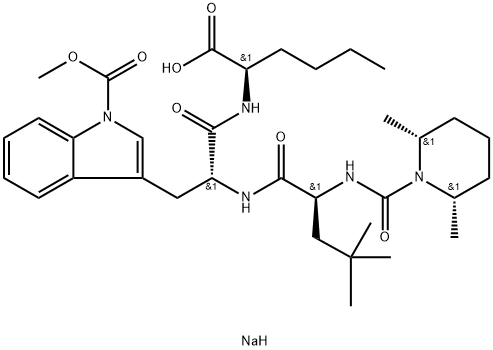
BQ-788 钠盐 性质
| 储存条件 | -20°C |
|---|---|
| 溶解度 | 在乙腈中的溶解度:0.3 mg/mL |
| 形态 | 固体 |
| 颜色 | 白色 |
| 水溶解性 | acetonitrile: 0.3mg/mL DMSO: 1.2mg/mL ethanol: 1.2mg/mL H2O: slightly soluble |
| InChIKey | IBWYJVKAVOHKHB-IAZAOAQXNA-N |
| SMILES | C(C1=CN(C(=O)OC)C2=CC=CC=C12)[C@H](C(=O)N[C@@H](C(=O)O)CCCC)NC(=O)[C@H](CC(C)(C)C)NC(N1[C@@H](CCC[C@@H]1C)C)=O.[NaH] |&1:14,18,29,38,42,r| |
BQ-788 钠盐 用途与合成方法
IC50: 1.2 nM (ETB)
BQ-788 potently and competitively inhibits 125 I-labeled ET-1 binding to ETB receptors in human Girrardi heart cells with an IC 50 of 1.2 nM, but only poorly inhibits the binding to ETA receptors in human neuro-blastoma cell line SK-N-MC cells (IC 50 , 1300 nM). BQ-788 shows no agonistic activity up to 10 μM and competitively inhibits thevasoconstriction induced by an ETB-selective agonist (pA2, 8.4). BQ-788 also inhibits several bioactivities of ET-1, such as bronchoconstriction, cell proliferation, and clearance of perfused ET-1.
BQ-788 (3 mg/kg/h, i.v.) completely inhibits a pharmacological dose of ET-1- or sarafotoxin6c (0.5 nmol/kg, i.v.)-induced ETB receptor-mediated depressor, but not pressor responses in conscious rats. Furthermore, BQ-788 markedly increases the plasma concentration of ET-1, which is considered an index of potential ETB receptor blockade in vivo. In Dahl salt-sensitive hypertensive (DS) rats, BQ-788 (3 mg/kg/h, i.v.) increases blood pressure by about 20 mm Hg. It is reported that BQ-788 also inhibits ET-1-induced bronchoconstriction, tumor growth and lipopolysaccharide-induced organfailure. BQ 788 (3 mg/kg) results in an eightfold leftward shift in the ET-1 dose-response curve, suggesting a significant involvement of ETB dilator receptors. Mice are treated with 30 nmol BQ-788 by intraplantar, reduce mechanical hyperalgesia (47% and 42%), thermal hyperalgesia (68% and 76%), oedema (50% and 30%); myeloperoxidase activity (64% and 32%), and overt-pain like behaviours. Additionally, intraplantar treatment with clazosentan or BQ-788 decreases spinal (45% and 41%) and peripheral (47% and 47%) superoxide anion production as well as spinal (47% and 47%) and peripheral (33% and 54%) lipid peroxidation, respectively.
BQ-788 钠盐 价格(试剂级)
| 更新日期 | 产品编号 | 产品名称 | CAS号 | 包装 | 价格 |
|---|---|---|---|---|---|
| 2026-09-15 | HY-15894 | BQ-788 钠盐 | 156161-89-6 | 1 mg | 1500 |
| 2026-09-15 | HY-15894 | BQ-788 钠盐 | 156161-89-6 | 5 mg | 3255 |
