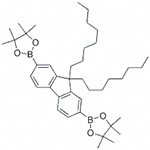
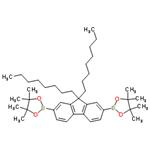
2,2'-(9,9-dioctyl-9H-fluorene-2,7-diyl)bis(4,4,5,5-tetramethyl-1,3,2-dioxaborolane) is a fluorene derivatives. It belongs to organic semiconducting materials and can be used in the synthesis of OLED, PLED, OFET, and Polymer Solar Cells.
9,9-Di-n-octylfluorene-2,7-diboronic acid bis(pinacol) ester is a reactant in the synthesis of 6,6-(5,5-(9,9-dioctyl-9H-fluorene-2,7-diyl)bis(thiophene-5,2-diyl))bis(2,5-bis(2-ethylhexyl)-3-(thiophen-2-yl)pyrrolo[3,4-c]pyrrole-1,4(2H,5H)-dione) (DPP1), a solution-processable nonfullerene electron acceptor used in organic solar cells.
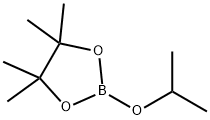
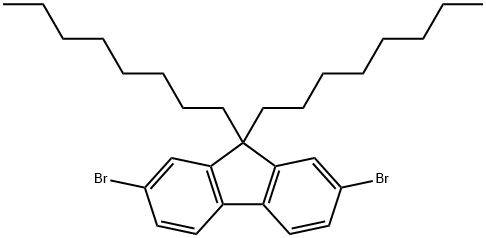
Under argon protection, 2,7-dibromo-9,9-dioctylfluorene (21.9 g, 40 mmol) and 250 mL of anhydrous tetrahydrofuran were added to a 500 mL three-neck flask. The reaction solution was cooled to -78°C (using a liquid nitrogen bath) and a n-hexane solution of n-butyllithium (48 mL, 2.5 M, 120 mmol) was added slowly and dropwise. After stirring at -78°C for 2 h, 2-isopropyl-4,4,5,5-tetramethyl-1,3,2-dioxaborolane (26 g, 140 mmol) was added all at once and the reaction mixture was allowed to naturally rise to room temperature. The reaction was continued for 20 hours. After completion of the reaction, the mixture was poured into water and extracted with dichloromethane. The organic phase was washed five times with saturated saline, the organic phase was separated, dried over anhydrous sodium sulfate, filtered and concentrated. The crude product was purified by column chromatography using silica gel as stationary phase and petroleum ether/dichloromethane as mobile phase. After purification, 43.8 g of white solid product was obtained in 80% yield.
[1] Journal of Materials Chemistry, 2003, vol. 13, # 4, p. 807 - 813
[2] Patent: CN106588869, 2017, A. Location in patent: Paragraph 0053; 0054; 0055; 0056
[3] Patent: KR101495152, 2015, B1. Location in patent: Paragraph 0152; 0159-0160
[4] Patent: CN106366067, 2017, A. Location in patent: Paragraph 0053; 0054; 0055; 0056
[5] Macromolecules, 2004, vol. 37, # 4, p. 1211 - 1218