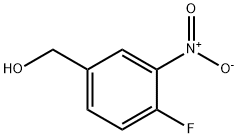
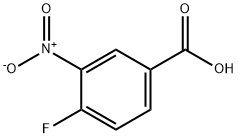
The general procedure for the synthesis of 3-nitro-4-fluorobenzyl alcohol from 4-fluoro-3-nitrobenzoic acid was as follows: sodium borohydride (2.70 g, 64.83 mmol) was dissolved in 100 mL of tetrahydrofuran and cooled to 0 °C. 4-Fluoro-3-nitrobenzoic acid (12.0 g, 64.83 mmol) was added in batches at 0 °C and the addition process lasted for 1 hour. Subsequently, boron trifluoride diethyl ether solution (6.55 mL, 71.31 mmol) was added dropwise at 0 °C. The reaction mixture was slowly warmed to room temperature and stirring was continued for 3 hours. Upon completion of the reaction, 500 mL of ethyl acetate and 300 mL of water were added to the mixture, which was layered and the organic phase was collected. The organic phase was washed with 500 mL of saturated sodium chloride solution and then dried with anhydrous sodium sulfate. The dried organic phase was filtered and the filtrate was concentrated under reduced pressure to give 3-nitro-4-fluorobenzyl alcohol (11.0 g, light yellow solid) in 99.1% yield.
[1] Patent: CN107400092, 2017, A. Location in patent: Paragraph 0293; 0295-0298
[2] Patent: CN108264511, 2018, A. Location in patent: Paragraph 0280; 0283-0286
[3] Patent: WO2012/171488, 2012, A1. Location in patent: Page/Page column 22-23
[4] Bioorganic and Medicinal Chemistry Letters, 2015, vol. 25, # 23, p. 5546 - 5550
[5] Patent: WO2017/89453, 2017, A1. Location in patent: Page/Page column 54