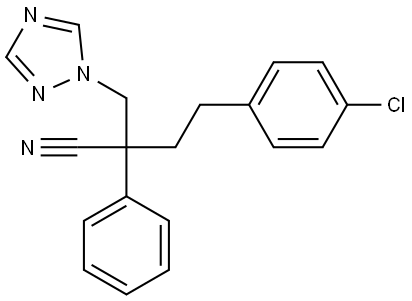
Fenbuconazole is a triazole fungicide with systemic, protectant and curative actions. It has a low aqueous solubility but is soluble in many organic solvents. It is not volatile. It can be persistent in both soil and water systems depending upon local conditions. Based on its physico-chemical properties, fenbuconazole is not expected to leach to groundwater. It is moderately toxic to most aquatic species as well as earthworms and honeybees. Oral toxicity is low but there are a few concerns regarding chronic toxicity.
Fenbuconazole is used for control of Septoria, Puccinia rusts, bunt,
smut and Rhyncosporium secalis on cereals; powdery mildew and scab on
pome fruit; brown rot and powdery mildew on stone fruit; powdery mildew,
black rot and grey mould on vines, rust on beans and bean leaf spot
on sugar beet. It is also used for control of a wide range of diseases on field
crops, rice, bananas, tree nuts, vegetables and ornamentals. It can also be
used in foliar, post-harvest and seed treatments.
Fenbuconazole is a conazole based fungicide used as a spray for the control of leaf spot, yellow and brown rust, powdery mildew and net blotch on wheat and barley and apple scab, pear scab and apple p
owdery mildew on apples and pears.
The commercial production of fenbuconazole involves a multi-step synthetic process that constructs its key structural features: a triazole ring, a phenyl group, and a butanenitrile side chain. The synthesis typically begins with the formation of the triazole moiety through cyclisation reactions involving hydrazines and carboxylic acid derivatives. This intermediate is then coupled with substituted aromatic compounds via nucleophilic substitution or palladium-catalysed cross-coupling to introduce the phenyl ring. The final step involves the attachment of the nitrile-containing side chain, often through alkylation or condensation reactions.
ChEBI: 4-(4-chlorophenyl)-2-phenyl-2-(1,2,4-triazol-1-ylmethyl)butanenitrile is a member of the class of triazoles that is 1-chloro-4-(3-phenylpropyl)benzene substituted at position 3 of the propyl moiety by cyano and 1,2,4-triazol-1-ylmethyl groups. It is a member of triazoles, a nitrile and a member of monochlorobenzenes.
Systemic, protectant and curative, acts by inhibiting sterol biosynthesis in fungi.
A number of sites in the fenbuconazole molecule are susceptible to
enzymic attack. Consequently, a large variety of metabolites may be
formed by oxidative attack on the phenolic rings or the aliphatic benzylic
carbon atom adjacent to the 4-chlorophenyl ring. In mammals, oxidation
at the benzylic carbon atom is an important pathway, which gives rise to
the corresponding alcohol or ketone. This pathway also leads to lactone
formation via hydrolysis of the nitrile group and elimination of a molecule
of water. The alcohol may also form conjugates with glucuronic or sulfuric
acid. Additional reactions in mammals involve hydroxylation of the
phenolic rings.
In plants, oxidation at the benzylic carbon is an important step to
further metabolites and cleavage of the linkage to the triazole ring generates
triazole, which is subsequently incorporated in a number of metabolic
products. Information presented in this entry is based on the PSD
Evaluation (PSD, 1995).
Fenbuconazole is thermally stable up to 150 °C and there was no observed
degradation when fenbuconazole was incubated in the dark in aqueous
solutions at pH 5,7 and 9 for up to 30 days at 25 °C.
When an aqueous solution of fenbuconazole (concentration 1.5μg ml-1,
pH 7) was irradiated with a xenon arc lamp (filtered to remove wavelengths
below 290 nm), the overall radioactivity was 105% of the original
amount and the only compound detected was fenbuconazole.