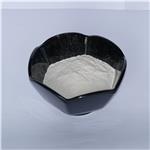
light orange to yellow-brown crystalline powder
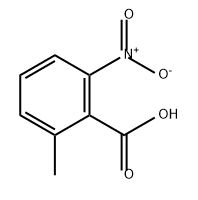
2-Methyl-nitrobenzoic acid acts as herbicide due to the anthranilic acid moiety within the substructure.
Pale yellow needles or tan powder.
2-METHYL-6-NITROBENZOIC ACID is a nitrated carboxylic acid. Carboxylic acids donate hydrogen ions if a base is present to accept them. They react in this way with all bases, both organic (for example, the amines) and inorganic. Their reactions with bases, called "neutralizations", are accompanied by the evolution of substantial amounts of heat. Neutralization between an acid and a base produces water plus a salt. Carboxylic acids with six or fewer carbon atoms are freely or moderately soluble in water; those with more than six carbons are slightly soluble in water. Soluble carboxylic acid dissociate to an extent in water to yield hydrogen ions. The pH of solutions of carboxylic acids is therefore less than 7.0. Many insoluble carboxylic acids react rapidly with aqueous solutions containing a chemical base and dissolve as the neutralization generates a soluble salt. Carboxylic acids in aqueous solution and liquid or molten carboxylic acids can react with active metals to form gaseous hydrogen and a metal salt. Such reactions occur in principle for solid carboxylic acids as well, but are slow if the solid acid remains dry.
Flash point data for 2-METHYL-6-NITROBENZOIC ACID are not available; however, 2-METHYL-6-NITROBENZOIC ACID is probably combustible.
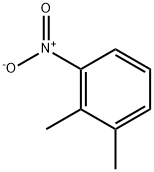
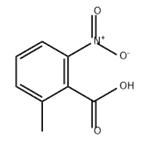
The general procedure for the synthesis of 2-methyl-6-nitrobenzoic acid from 3-nitro-o-xylene was as follows: 1,2-dimethyl-3-nitrobenzene (453 mg, 3 mmol, 1.0 eq.) was added to a 100 mL autoclave with sodium hydroxide (0.9 g, 22.5 mmol, 7.5 eq.), followed by the addition of 5 mL of ethanol. After passing oxygen three times, the oxygen pressure was maintained at 1.8 MPa and the reaction was carried out in an oil bath at 65°C for 24 hours. Upon completion of the reaction, the reaction mixture was diluted with methanol and the pH was adjusted to 6-7 for neutralization. After removing the solvent under reduced pressure, ethyl acetate was added and the mixture was dried. Separation by column chromatography gave 47 mg (0.31 mmol) of unreacted 1,2-dimethyl-3-nitrobenzene with 90% conversion. The target product 2-methyl-6-nitrobenzoic acid 350 mg (1.93 mmol) was also obtained in 64% yield.
[1] Patent: CN106995374, 2017, A. Location in patent: Paragraph 0121; 0122; 0123
[2] Journal of Organic Chemistry, 2018, vol. 83, # 15, p. 8092 - 8103