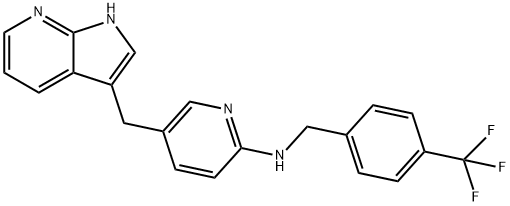
PLX647 is a dual inhibitor of the receptor tyrosine kinases FMS and KIT (IC50s = 28 and 16 nM, respectively). It is selective for FMS and KIT but does inhibit FLT3 and KDR (IC50s = 91 and 130 nM, respectively) in a panel of 400 kinases at a concentration of 1 μM. PLX647 inhibits proliferation of Ba/F3 cells expressing constitutively active FMS or KIT (IC50s = 92 and 180 nM, respectively) as well as ligand-dependent growth of M-NFS-60 and M-07e cells that express endogenous FMS and KIT, respectively (IC50s = 380 and 230 nM, respectively). It has no effect on HEK293T or HepG2 cells that lack FMS and KIT (IC50 = >50 μM) or Ba/F3 cells overexpressing KDR (IC50 = >5 μM). PLX647 also inhibits differentiation of human osteoclast precursor cells (IC50 = 170 nM). In vivo, PLX647 (40 mg/kg) reduces TNF-α and IL-6 release in a rat model of LPS-induced cytokine release. It reduces mast cell degranulation in a mouse model of passive cutaneous anaphylaxis (PCA) and inhibits bone destruction and delays disease progression in a mouse model of collagen-induced arthritis (CIA). PLX647 also reverses bone osteolysis and allodynia in a syngeneic rat model of cancer-induced bone pain.
PLX647 is a novel tyrosine kinase (TK) inhibitor, which selectively targets c-Kit and c-Fms.
PLX647 (40 mg/kg; p.o.; twice daily for 7 days) reduces macrophage accumulation in UUO kidney and blood monocytes[1].
PLX647 (40 mg/kg; p.o.; male Swiss Webster mice) reduces LPS-induced TNF-α and IL-6 release[1].
PLX647 (20-80 mg/kg; p.o.; daily or twice daily from 27-41 days) shows effects on collagen-induced arthritis[1].
PLX647 (30 mg/kg) results in significant inhibition of TRAP5b immunostaining and bone osteolysis. PLX647 (30 mg/kg BID) is able to prevent bone damage by the tumor cells[1].
| Animal Model: | Male C57BL/6 mice (mouse unilateral ureter obstruction model)[1] |
| Dosage: | 40 mg/kg |
| Administration: | P.o.; twice daily for 7 days |
| Result: | Resulted in reduction in the levels of F4/80+ macrophages by 77%.
|
| Animal Model: | 7-9 wk old Male DBA/1J mice (Mouse collagen-induced arthritis model)[1] |
| Dosage: | 20 mg/kg, 80 mg/kg |
| Administration: | P.o.; daily (20 mg/kg) from 27-41 days, twice daily (80 mg/kg) from 27-41 days |
| Result: | 20 mg/kg PLX647 had no initial effect on the development of severe arthritis. However, starting on day 33, no further development of disease severity was recorded, and a 30% inhibition of the macroscopic signs of arthritis was evident in clinical score on day 41. Mice treated with 80 mg/kg BID PLX647 initially shows delayed development of severe arthritic signs. Starting on day 33, the signs of arthritis began to decrease in this treatment group, reaching a maximum reversal of 76% on day 41.
|
[1]. zhang c, ibrahim pn, zhang j, et al. design and pharmacology of a highly specific dual fms and kit kinase inhibitor. proc natl acad sci u s a, 2013, 110(14): 5689-5694.