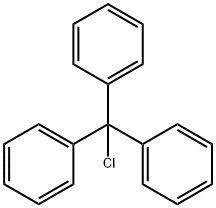
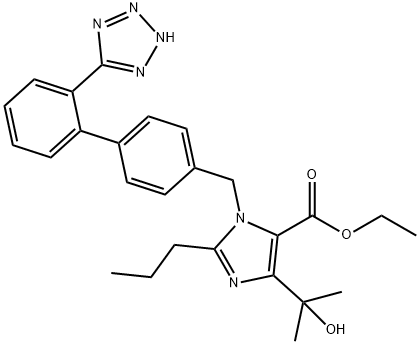
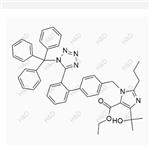
To ethyl 4-(1-hydroxy-1-methylethyl)-2-propyl-1-[4-[2-(tetrazol-5-yl)phenyl]phenyl]methylimidazole-5-carboxylate (BIH, 100 g, 1 eq.) was added dichloromethane (500 mL, 5 vol.), and stirred until completely dissolved. Triethylamine (32.3 mL, 1.1 eq.) was added and the reaction mixture was cooled to 0 °C - 5 °C. A solution of triphenylchloromethane (63.22 g, 1.08 eq.) in dichloromethane (300 mL, 3 vol.) was slowly added dropwise over 30 min at 0 °C-5 °C. After the dropwise addition was completed, the reaction mixture was warmed to 25°C-30°C with continuous stirring for 12 hours. Triphenylchloromethane (2.92 g, 0.05 eq.) was added additionally and stirring was continued for 3 hours. The reaction was monitored by thin layer chromatography (TLC, unfolding agent: 10% methanol/dichloromethane, UV detection) to confirm complete conversion of BIH. The reaction mixture was cooled to 0°C-5°C, demineralized water (270 mL, 2.7 v/v) was added, and stirred at 25°C-30°C for 15 min. Layers were left to separate and the aqueous phase was extracted with dichloromethane (200 mL, 2 volumes). The organic phases were combined and washed with deionized water (500 mL, 5 volumes). The organic phase was dried over anhydrous sodium sulfate, filtered, and the filtrate was concentrated under reduced pressure at 40°C-45°C to afford ethyl 4-(1-hydroxy-1-methylethyl)-2-propyl-1-[4-[2-(triphenylmethyltetrazol-5-yl)phenyl]phenyl]methylimidazole-5-carboxylate (BIT, 135 g, 89% yield).

![1H-IMidazole-5-carboxylic acid, 4-(1-hydroxy-1-Methylethyl)-2-propyl-1-[[2'-[1-(triphenylMethyl)-1H-tetrazol-5-yl][1,1'-biphenyl]-4-yl]Methyl]-, ethyl ester Structure](/CAS/GIF/144690-33-5.gif)
![1H-IMidazole-5-carboxylic acid, 4-(1-hydroxy-1-Methylethyl)-2-propyl-1-[[2'-[1-(triphenylMethyl)-1H-tetrazol-5-yl][1,1'-biphenyl]-4-yl]Methyl]-, ethyl ester pictures](/ProductImageEN3/2026-07/Small/904c5217-eac4-43a9-a539-e178aeb51d0d.jpg)
![1H-IMidazole-5-carboxylic acid, 4-(1-hydroxy-1-Methylethyl)-2-propyl-1-[[2'-[1-(triphenylMethyl)-1H-tetrazol-5-yl][1,1'-biphenyl]-4-yl]Methyl]-, ethyl ester pictures](/ProductImageEN/2022-09/Small/fffbce8f-99f7-4f51-953f-721a954e8352.png)