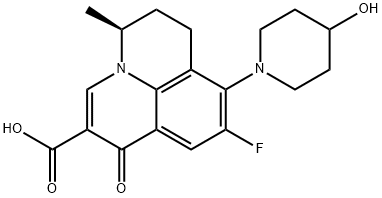
(S)-(-)-Nadifloxacin is an anti-bacterial agent against multidrug-resistant Staphylococcus aureus. Also, it is derived from 6-Fluoro-2-methylquinoline (F595900), which is an quinoline derivative, a highly potent thrombin receptor antagonist.
ChEBI: (S)-nadifloxacin is a nadifloxacin. It is an enantiomer of a (R)-nadifloxacin.
Levonadifloxacin is a potent benzoquinolizine fluoroquinolone antibiotic th at is affective against Gram-positive and Gram-negative bacteria, including methicillin- and quinolone-resistant Staphylococcus aureus, Streptococcus pneumoniae, Streptococcus pyogenes, Haemophilus influenzae, and Moraxella catarrhalis and atypical pathogens. It appears th at Levonadifloxacin targets staphylococcal DNA gyrase, unlike other quinolones, which primarily inhibit DNA topoisomerase IV.
Starting from 2-bromo-4,5-difluoroacetylaniline, it was reacted with crotonaldehyde under Skraup-Doeber-VonMiller reaction conditions to generate quinoline 2 in 67% yield. Pd-on-carbon catalytic hydrogenation was used to reduce the carbon-bromine bond in 2, and the catalyst was removed by filtration. Platinum-on-carbon was added to the reaction mixture and the hydrogenation conditions were again applied to give tetrahydroquinoline 3 in 97% yield. Tetrahydroquinoline 3 was reacted with 2,3-di-O-benzyl-L-tartaric acid (L-DBTA) and subsequently recrystallized from 60% methanol-water solution to give S-isomer 4 in 35% yield and 100% enantiomeric excess. The recovered R-isomer could be racemized by treatment with methanesulfonic acid. Compound 4 was reacted with diethylethoxymethylvinylmalonate in polyphosphoric acid and subsequently treated with hydrochloric acid to give tricyclic acid 5 in 88% yield. The tricyclic acid 5 chelates with the in situ generated borotriacetate to form the cyclic boronic ester complex 6. The cyclic boronic ester complex 6 is reacted with 4-hydroxypiperidine to afford levonadifloxacin 8 in good yield in a two-step reaction.

Levofloxacin is a fluoroquinolone antibiotic that works by inhibiting bacterial DNA gyrase.
(S)-(-)-Nadifloxacin is 60-250 times more potent than its R-isomer, nadifloxacin.