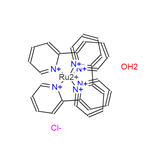
Tris (2,2’-bipyridyl) dichlororuthenium hexahydrate (RTDP, Ru (BPY) 3) is an oxygen-sensitive fluorescent stain. It can be used to measure the oxygen concentration of microfluidic chips.
Tris(2,2'-bipyridine)dichlororuthenium(II) hexahydrate is a catalyst used in light-induced redox reactions, and is an important catalyst in studies towards photochemical water splitting. This product is widely applied in fields of photoelectrical chemical components, photovoltaic cells, smart biosensors.
red to orange powder or crystals
Tris(2,2'-bipyridine)dichlororuthenium(II) hexahydrate is a catalyst used in light-induced redox reactions. It is an important catalyst in studies towards photochemical water splitting. This product can be used as a catalyst in pharmaceutical research. It is widely applied in fields of photoelectrical chemical components, photovoltaic cells, smart biosensors.
Tris(2,2′-bipyridyl)dichlororuthenium(II) hexahydrate is a metal complex and is used as an luminescent dye. The metal complex in its ground state can be excited by visible light which leads to the formation of a spin-allowed excited state. This excited state undergoes radiationless deactivation very quickly to form spin-forbidden, long-lived luminescent excited state. It is used widely in electroluminescent devices.
core: ruthenium
reaction type: Photocatalysis
reagent type: catalyst
Dried RuCl3 (200 mg, 0.964 mmol) and 2,2-bipyridine (452 mg, 2.89 mmol) were dissolved in H2O (20 mL). Saturated naapo2h2 (2 ml) was added to the mixture. The resulting mixture was heated to reflux for 30 min. The reaction mixture was filtered. Potassium chloride (6.3 g, 84.5 mmol) was added to the filtrate. The mixture was heated to boiling. The reaction mixture was allowed to cool to room temperature. The crystals obtained were collected by filtration. The mixture was washed with cold acetone and recrystallized from water to give tris(bipyridyl)ruthenium(II) chloride.
Recrystallise it from water, then from MeOH [Ikezawa et al. J Am Chem Soc 108 1589 1986].


![[Ru (bpy)3] Cl2·6H2O pictures](/ProductImageEN/2021-09/Small/fb45cc9a-945b-4fe4-aa9e-8962c0b8841a.png)