4-Chloro-7-(3-chloropropoxy)-6-methoxyquinoline-3-carbonitrile (31.2 g, 0.10 mol), 2,4-dichloro-5-methoxyaniline (21.1 g, 0.11 mol), and pyridine hydrochloride (12.8 g, 0.11 mol) were used as raw materials and mixed in 2-methoxyethanol (150 g). The reaction mixture was heated to 120 °C and maintained at this temperature for 3 hours. After completion of the reaction, the suspension was cooled to room temperature. The reaction mixture was slowly poured into water (600 g) under continuous stirring. The resulting solid product was collected by filtration and washed with water (2 x 40 g). Subsequently, the product was dried at 50 °C to afford 7-(3-chloropropoxy)-4-[(2,4-dichloro-5-methoxyphenyl)amino]-6-methoxy-3-cyanoquinoline (35.9 g, 77% yield) as an off-white solid. The structure of the product was confirmed by 1H NMR, 13C NMR and mass spectrometry (ESI).1H NMR (400 MHz, DMSO-d6) δ: 2.28 (m, J = 6.0 Hz, 2H), 3.82 (t, J = 6.0 Hz, 2H), 3.87 (s, 3H), 3.97 (s, 3H), 4.30 (t, J = 6.0 Hz, 2H). 7.35 (s, 1H), 7.37 (s, 1H), 7.75 (s, 1H), 7.85 (s, 1H), 8.43 (s, 1H), 9.63 (s, 1H).13C NMR (100 MHz, DMSO-d6) δ: 31.9, 42.1, 56.7, 57.3, 65.8, 86.9, 102.4, 110.0, 113.1, 114.0, 117.4, 120.9, 123.6, 130.3, 136.7, 146.2, 149.8, 149.9, 151.3, 152.9, 154.5. mass spectrum (ESI) m/z: 468.0 [M + H]+.


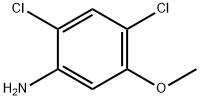

![7-(3-Chloropropoxy)-4-[(2,4-dichloro-5-methoxyphenyl)amino]-6-methoxy-3-quinolinecarbonitrile pictures](https://img.chemicalbook.com/ProductImageEN/2018-7/Small/0865fa1d-0296-45fd-8c7f-c6a31748842f.gif)