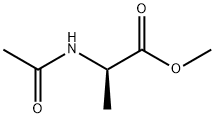
GENERAL METHODS: 438.5 mg (2.00 mmol) of the α-dehydroamino acid 2-(N-acetamido)-3-phenyl-2-propenoic acid methyl ester was used as a substrate for the reaction, and 1.55 mg of (2.RxR)-1,2-bis(tert-butylmethylphosphinato)-4,5-(methylenedioxy)benzyl)(1,5-cyclooctadienyl) rhodium (1+) hexafluoroantimonate was added as an asymmetric hydrogenation catalyst. The reaction system was purged five times with hydrogen and 5 mL of predegassed anhydrous methanol was added. Subsequently, the reaction was initiated by setting the hydrogen pressure to 3 atmospheres. After stirring at room temperature for 30 min, it was observed that the consumption of hydrogen stopped, indicating the completion of the reaction. The reaction solution was concentrated and the residual white crystals were dissolved in ethyl acetate and purified by silica gel column chromatography.HPLC analysis of the eluent afforded methyl (R)-2-(N-acetylamino)-3-phenylpropionate with an enantiomeric excess (ee) of 99.9%. In addition, the chemical yield of the compounds was confirmed to be 99% or higher by 1H NMR analysis (corresponding to No. 1 in Table 1).The HPLC conditions were as follows: a Daicel Chiralcel OJ column at a flow rate of 1.0 mL/min, a mobile phase of hexane:2-propanol (9:1), and the retention times of the enantiomers were (R)-13.3 min, (S)-19.3 Under the same asymmetric hydrogenation reaction conditions, only the reaction substrate and reaction conditions were changed (as shown in Table 1), and the reaction results are also listed in Table 1.
[1] Journal of the American Chemical Society, 1993, vol. 115, # 22, p. 10125 - 10138
[2] Journal of Organometallic Chemistry, 2001, vol. 621, # 1-2, p. 130 - 142
[3] Synthesis, 2004, # 9, p. 1353 - 1358
[4] Tetrahedron Letters, 2005, vol. 46, # 34, p. 5643 - 5646
[5] Tetrahedron Letters, 2006, vol. 47, # 25, p. 4263 - 4266