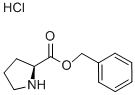
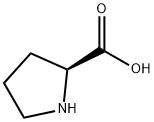
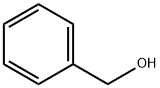
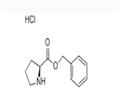
Under nitrogen protection, benzyl alcohol (70 mL, 651 mmol) was cooled to 0 °C and thionyl chloride (7.0 mL, 91.2 mmol) was added slowly and dropwise. L-proline (5.0 g, 43.4 mmol) was then added, and the reaction system was kept stirred at 0 °C and under nitrogen atmosphere for 2 hours. The temperature was slowly increased to room temperature and stirring was continued for 48 hours. Upon completion of the reaction, the reaction mixture was slowly poured into ether (300 mL) and left to crystallize at -20°C for 7 days. The resulting white solid precipitate was collected by filtration, washed with ether and dried under vacuum to give L-proline benzyl ester hydrochloride (9.88 g, 93% yield). The product characterization data were as follows: melting point 142.1-144.0 °C (literature value: 143-144 °C); 1H NMR (300 MHz, CDCl3): δ 7.41-7.21 (m, 5H), 5.16 (s, 2H), 3.80 (dd, J = 3.83, 5.9 Hz, 1H), 3.15-3.01 (m, 1H), 3.00-2.82 (m, 1H), 2.42-2.21 (m, 1H), 2.13 (dd, J = 12.9, 7.5 Hz, 1H), 1.92-1.62 (m, 3H); 13C NMR (75 MHz, CDCl3): δ 175.5, 136.0, 128.8, 128.5, 128.3, 66.9, 59.9, 47.2, 30.4, 25.6. Elemental analysis (C12H16ClNO2) calculated values: C, 59.63; H, 6.67; N, 5.79; measured values: C, 59.50; H, 6.86; N, 5.64.