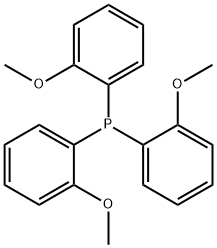
2-liter reaction vessel equipped with a thermometer, mechanical stirrer, dropping funnel, and reflux condenser was connected to an inert gas source and loaded with 113 g (1.04 mol) of anisole and 250 ml of MTBE. After degassing, 440 ml (0.70 mol) of n-butyllithium (1.6 M in hexane) was added over 1 hour, during which time the temperature was gradually increased to the reflux temperature (approximately 60 °C). After maintaining this temperature for 16 hours, the reactor contents were cooled to ambient temperature (at which point GC analysis showed a n-butyllithium conversion > 99%, with the formation of a corresponding amount of 2-thioanisole). Next, a mixture of 100 ml of MTBE and 19.3 ml (31.0 g, 0.225 mol) of phosphorus trichloride was added at a rate not exceeding 30 °C. After the addition was complete, the white/yellow suspension was stirred for another 4 hours. Subsequently, 30 ml of water was added, and the white precipitate was filtered off. Next, the white solid was washed with methanol (2 × 200 ml), filtered, and dried under vacuum (1 mbar, 60 °C). Yield: 63.4 g (80%) of a fine white powder, which, according to 1H NMR and 31P NMR, is >99% pure TOMPP.
Tris(2-methoxyphenyl)phosphine is a phosphine ligand used for catalysis. It is used as a catalyst for allylic substitution of simple alkenes, suzuki coupling reactions, hydrogenation of quinolines and other addition reactions.
Tris(2-Methoxyphenyl)phosphine causes skin irritation and serious eye irritation, and may cause long lasting harmful effects to aquatic life.
reaction type: Buchwald-Hartwig Cross Coupling Reaction
reaction type: Heck Reaction
reaction type: Hiyama Coupling
reaction type: Negishi Coupling
reaction type: Sonogashira Coupling
reaction type: Stille Coupling
reaction type: Suzuki-Miyaura Coupling
reagent type: ligand
Treatment of the diiron hexacarbonyl complexes [μ-SCH2CH(R)S-μ]Fe2(CO)6 with a monophosphine ligand tris(2-methoxyphenyl)phosphine in the presence of Me3NO 2H2O gave monosubstituted complexes [μ-SCH2CH(R)S-μ]Fe2(CO)5[P(C6H4OCH3-2)3] in 60–89% yields.
[1] Raymond C. Bott, Graham Smith, Peter C. Healy. “Structural studies of two-coordinate complexes of tris(2-methoxylphenyl)phosphine and tris(4-methoxyphenyl)phosphine with gold(I) halides.” Polyhedron 26 12 (2007): Pages 2803-2809.
[2] O. Shawkataly. “Pentacarbonyl[tris(2-methoxyphenyl)phosphine-P]chromium and its Molybdenum Analogue.” Acta crystallographica. Section C, Crystal structure communications 75 1 (1996): 1352–1355.