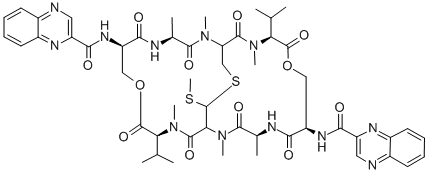
Hypoxia-inducible factor-1 (HIF-1) is a transcription factor that controls genes involved in glycolysis, angiogenesis, migration, and invasion. Echinomycin is a cell-permeable inhibitor of HIF-1-mediated gene transcription. It acts by intercalating into DNA in a sequence-specific manner, blocking the binding of either HIF-1α or HIF-1β to the hypoxia-responsive element. Echinomycin reversibly inhibits hypoxia-induced HIF-1 transcription activity in U215 cells with an EC50 value of 1.2 nM. It inhibits hypoxia-induced expression of vascular endothelial growth factor, blocking angiogenesis and altering excitatory synaptic transmission in hippocampal neurons. Echinomycin also impairs expression of survivin, enhancing the sensitivity of multiple myeloma cells to melphalan.
Quinomycin A is a cyclic depsipeptide metabolite. Quinomycin A has broad activity against bacteria, fungi and viruses, and has found application as an antitumor agent. Quinomycin A acts by bifunctional intercalation of nucleic acids. Recent research has shown quinomycin A to be an extremely potent inhibitor of hypoxia-inducible factor-1 (HIF-1). This transcription factor plays an essential role in tumor progression and metastasis.
Quiniomycin A is a cyclic depsipeptide metabolite. Quinomycin A has broad activity against bacteria, fungi and viruses, and has found application as an antitumour agent. Quinomycin A acts by bifunctional intercalation of nucleic acids. Recent research has shown quinomycin A to be an extremely potent inhibitor of hypoxia-inducible factor-1 (HIF-1). This transcription factor plays an essential role in tumour progression and metastasis.
Echinomycin has been used for inhibition of hypoxia-inducible factor 1.
Echinomycin is an antitumor antibiotic and potent hypoxia inducible factor 1α (HIF-1α) inhibitor. It binds to DNA via bifunctional intercalation, blocking the binding of HIF-1α, a transcription factor important in tumor growth. Echinomycin selectively eliminated cancer stem cells in a study with mouse lymphoma and human AML xenogeneic models, eradicating the lymphomas. Recently, echinomycin was also found to act as an antibiotic adjuvant having synergistic effects with novobiocin in gram negative bacteria.
Echinomycin (10 μg/kg; intravenous injection; for 40 days; NOD-SCID mice) treatment efficiently eradicates mouse lymphoma and serially transplantable human acute myeloid leukemia (AML) in xenogeneic model by preferential elimination of cancer stem cells (CSCs). HIF1α maintains mouse lymphoma CSCs by repressing a negative feedback loop in the Notch pathway[2].
| Animal Model: | NOD-SCID mice received 1.8Gy of irradiation and i.v. injection with peripheral blood cells from patients AML-71 and AML-150[2] |
| Dosage: | 10 μg/kg |
| Administration: | Intravenous injection; for 40 days |
| Result: | Efficiently eradicated mouse lymphoma and serially transplantable human AML in xenogeneic model by preferential elimination of CSCs.
|
The small-molecule Echinomycin is an inhibitor of hypoxia-inducible factor 1, an important transcription factor controlling the expression of genes that facilitate the response to a hypoxic environment. Cellular response to hypoxia involves angiogenesis, erythropoiesis, cell cycle, metabolism, and apoptosis, all of which are important for metastasis and tumor progression. Echinomycin inhibits HIF-1α and HIF-1β binding to a hypoxia-responsive element sequence of promoters of hypoxia-responsive genes. Echinomycin eliminated the ability of mouse lymphoma and human acute myeloid leukemia cancer stem cells to form colonies, and inhibited human AML in a xenogeneic model through preferential elimination of cancer stem cells. Inhibition of HIF-1α by Echinomycin can reduce the effects of acute graft-versus-host disease and extend leukemia free survival following allogeneic hematopoietic stem cell transplantation. Echinomycin inhibited adipogenesis and suppressed adipocyte differentiation in 3T3-L1 WAT preadipocytes, which may lead to a new therapeutic approach targeting obesity and diabetes.
[1] DEHE KONG. Echinomycin, a small-molecule inhibitor of hypoxia-inducible factor-1 DNA-binding activity.[J]. Cancer research, 2005, 65 19: 9047-9055. DOI:
10.1158/0008-5472.can-05-1235[2] YIN WANG. Echinomycin protects mice against relapsed acute myeloid leukemia without adverse effect on hematopoietic stem cells.[J]. Blood, 2014, 124 7: 1127-1135. DOI:
10.1182/blood-2013-12-544221[3] YIN WANG. Targeting HIF1α eliminates cancer stem cells in hematological malignancies.[J]. Cell stem cell, 2011, 8 4: 399-411. DOI:
10.1016/j.stem.2011.02.006[4] RAN LI . Hypoxia-inducible factor-1α regulates the expression of L-type voltage-dependent Ca2+ channels in PC12 cells under hypoxia[J]. Cell Stress & Chaperones, 2015, 20 3: Pages 507-516. DOI:
10.1007/s12192-015-0575-2