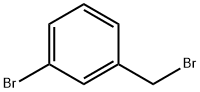
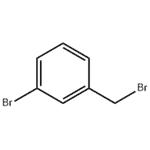
3-Bromobenzyl bromide was used in the synthesis of, 1,7-di(3-bromobenzyl)cyclen and substituted 8-arylquinoline, phosphodiesterase 4 (PDE4) inhibitors.
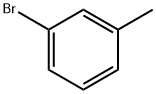
General procedure for the synthesis of 3-bromobenzyl bromide from 3-bromomethylbenzene: To a mixture of N-bromosuccinimide (NXS) and substrate (1 or 6) in acetonitrile (CH3CN), silicon tetrachloride (SiCl4) was slowly added at room temperature, and the reaction mixture was stirred continuously until thin-layer chromatography (TLC) monitoring showed complete disappearance of the feedstock. Subsequently, the reaction mixture was poured into water and extracted with dichloromethane (CH2Cl2). All organic phase extracts were combined and dried with anhydrous magnesium sulfate (MgSO4), followed by concentration under reduced pressure to remove the solvent. The residue was purified by recrystallization (petroleum ether-ether, 3:1) to give the pure products 2b-2g or 3b; or by silica gel column chromatography (hexane-ethyl acetate, 10:1 or 30:1) to give the pure products 2a, h, i, 3a-5 or 7-9.
[1] Journal of Organic Chemistry, 2014, vol. 79, # 1, p. 223 - 229
[2] Synthetic Communications, 2010, vol. 40, # 7, p. 998 - 1003
[3] Tetrahedron Letters, 2011, vol. 52, # 31, p. 4026 - 4029
[4] Patent: US2009/12171, 2009, A1. Location in patent: Page/Page column 11
[5] Patent: WO2005/105736, 2005, A1. Location in patent: Page/Page column 28