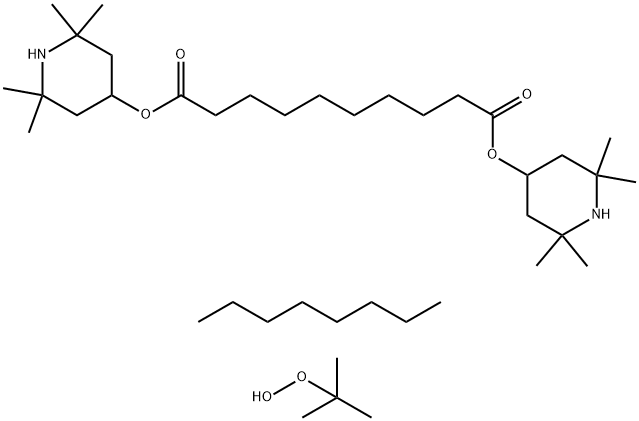
In a 500mL three-necked flask equipped with a condenser, a constant-pressure dropping funnel, a water separator, and a mechanical stirrer, di(2,2,6,6-tetramethyl-tetrahydroxypiperidine) sebacate aminooxy radical (A), n-octane (C), and catalyst (D) were added. After stirring and heating to dissolve, 70% tert-butyl hydrogen peroxide (B) was added dropwise to the reaction flask. After the addition was complete, the reaction was maintained at the desired temperature. After the reaction was completed, the reaction solution was cooled to room temperature, and the catalyst was filtered off. Under stirring conditions, an appropriate amount of sodium sulfite aqueous solution was added dropwise to the mother liquor to decompose excess tert-butyl hydrogen peroxide. Stirring was stopped when the solution did not change color when tested with starch-potassium iodide test paper. The aqueous layer was separated, and the organic layer was washed twice with hot water and decolorized with activated carbon. The washed and decolorized organic phase was distilled under reduced pressure using a rotary evaporator to remove n-octane, yielding a pale yellow oily product, which is the target product, Bis-(1-octyloxy-2,2,6,6-tetramethyl-4-piperidinyl) sebacate.
Easily emulsified in water-borne systems. Miscible to >50% with xylene, MEK, and other paint solvents.
Bis(1-octyloxy-2,2,6,6-tetramethyl-4-piperidyl) sebacate is a hindered amine light stabilizer (HALS) that is effective in retarding degradation through thermal and photo-oxidation process. It can be used in wood and plastic based coatings.