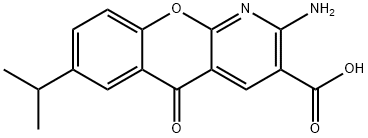
Amlexanox is an orally-active antiasthmatic agent useful in the treatment of bronchial
asthma and allergy-related sinus disorders. The therapeutic effect of amlexanox appears
to be attributed to its inhibitory actions on leukohiene D4, PAF and histamine.
Inhibits release of allergic mediators from mast cells. Antiallergic; antiasthmatic
ChEBI: A pyridochromene-derived monocarboxylic acid having an amino substituent at the 2-position, an oxo substituent at the 5-position and an isopropyl substituent at the 7-position.
A mixture of 2 ml of morpholine, 3 ml of dimethylformamide and 10 ml of
water was heated to 60°C and under stirring the equal molecular quantity of
6-isopropyl-4-oxo-4H-1-benzopyran-3-carbonitrile was added for 5 minutes.
The mixture was heated at that temperature for one hour and the resultant
precipitate was filtered, rained with water recrystallized from acetic acid and
washed with chloroform. By the above procedure was obtained 2-amino-6-
isopropyl-4-oxo-4H-1-benzopyran-3-carboxaldehyde melting at 206°-208°C. A
mixture of 4 ml ethyl cyanoacetate, 50 ml of ethanol, 5 ml of piperidine and
the equal molecular quantity of 2-amino-6-isopropyl-4-oxo-4H-1-benzopyran-
3-carboxaldehyde was refluxed for 30 minutes and, after cooling, the
crystalline precipitate was filtered and washed with chloroform. By above
procedure was obtained ethyl-2-amino-7-isopropyl-1-azaxanthone-3-
carboxylate, melting after recrystallization from ethanol at 243°-244°C. A
mixture of 10 ml of acetic acid and 10 ml of 55% sulfuric acid the equal
molecular quantity and 2-ethyl-amino-7-isopropyl-1-azaxanthone-3-
carboxylate was stirred at 130°C for 4 hours and, after water was added, the
precipitate was collected by filtration and recrystalllized from
dimethylformamide to give the 2-amino-7-(1-methylethyl)-5-oxo-5H-
[1]benzopyrano[2,3-b]pyridine-3-carboxylic acid, melting point 300°C.
Amlexanox is an anti-allergic drug with anti-inflammatory properties.
Amlexanox elevates the amount of nonsense-containing mRNAs in treated cells and helps to generate full-length proteins effectively.
Amlexanox is an anti-allergic and anti-inflammatory drug that was once commonly used to treat recurrent aphthous ulcers. It has also been effective in treating asthma, hay fever, and conjunctivitis, possibly through reducing the release of histamine and leukotriene from leukocytes and mast cells. Amlexanox binds and inhibits the non-canonical IκB kinases IKK-ε and TANK-binding kinase 1, inhibiting inflammation. Studies in obese mice treated with Amlexanox show that mice develop increased thermogenesis, producing increased insulin sensitivity and weight loss. These findings suggest a potential role for Amlexanox in the treatment of diabetes, obesity, and related disorders. Further, Amlexanox has demonstrated anti-cancer properties in numerous mouse models and appears to bind to at least 12 different enzyme and non-enzyme proteins. Binding of Amlexanox to the molecular chaperone HSP90 inhibits C-terminal chaperone activity and disrupts the multichaperone complex, while interaction with the calcium-binding proteins S100A12 and S100A13 is associated with an inhibition of FGF1 release and reduced cell migration and proliferation.
[1] KOCH L. Teaching an old drug new tricks—amlexanox targets inflammation to improve metabolic dysfunction[J]. Nature Reviews Endocrinology, 2013, 9 4: 185-185. DOI:
10.1038/nrendo.2013.42[2] SHANNON M REILLY. An inhibitor of the protein kinases TBK1 and IKK-ɛ improves obesity-related metabolic dysfunctions in mice[J]. Nature Medicine, 2013, 19 3: 313-321. DOI:
10.1038/nm.3082[3] S. NASRY. Different modalities for treatment of recurrent aphthous stomatitis. A Randomized clinical trial[J]. Journal of Clinical and Experimental Dentistry, 2016, 8 1: e517-e522. DOI:
10.4317/jced.52877[4] CHAPING CHENG. Aphthous ulcer drug inhibits prostate tumor metastasis by targeting IKKɛ/TBK1/NF-κB signaling.[J]. Theranostics, 2018: 4633-4648. DOI:
10.7150/thno.26687