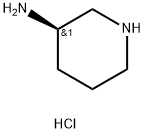
The main synthetic methods for (R)-3-Piperidinamine dihydrochloride are as follows: 1. Starting with 3-aminopyridine, racemic 3-aminopiperidine is obtained by catalytic hydrogenation reduction, followed by resolution with a chiral reagent to obtain (R)-3-aminopiperidine. This method has a low yield and requires a high-pressure reactor and expensive catalysts for the catalytic reduction of 3-aminopyridine, making it difficult to operate in practice. 2. Starting with D-ornithine hydrochloride, it is reacted with thionyl chloride between -78 and 45 °C, and then passed through a strongly basic anion exchange resin to obtain crude (R)-3-aminopiperidine-2-one. After purification, it is reduced to (R)-3-aminopiperidine by LiAlH4, and finally to hydrochloride. This method uses chiral ornithine as the starting material, and racemic reaction occurs during the synthesis process. Ornithine is expensive, and the reaction is carried out at a very low temperature (-78 °C), making it difficult to operate. In addition, it uses lithium aluminum hydride, which is prone to explosion, increasing the operating cost. 3. Using nicotinamide as a raw material, catalytic hydrogenation reduction, Boc protection, Hofman degradation, chiral resolution, and deprotection to form hydrochloride are employed. This step involves milder reaction conditions compared to the previous routes. Although the catalytic hydrogenation of nicotinamide is relatively demanding, there is significant room for improvement. 4. Using racemic 3-piperidincarboxamide as a raw material, (S)-3-piperidincarboxamide is decomposed by bacteria (Cupriavidus sp. KNK-J915) to obtain (R)-3-piperidincarboxamide. Then, the amino group undergoes Boc protection, Hofman degradation, and deprotection to form hydrochloride. This method is relatively novel, using bacteria (Cupriavidus sp. KNK-J915) to decompose the S-configuration isomer as a carbon source to obtain the opposite R-configuration isomer. However, the bacterial decomposition separation process requires high precision and has high operating costs, making large-scale industrial production currently difficult.