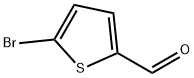
Under argon protection, 5-bromo-2-thiophenecarboxaldehyde (19.1 g, 0.1 mol) and ethyl azidoacetate (51.6 g, 0.4 mol) were dissolved in anhydrous ethanol (800 mL) in a 2 L four-necked flask and the air in the reaction system was displaced by a stream of argon gas. An ethanolic solution of sodium mass ethanolate (136 g, 0.4 mol) was slowly added dropwise to the above mixed solution under the condition of cooling to 0 °C in an ice bath, followed by stirring the reaction for 2 hours at 0 °C. After completion of the reaction, saturated aqueous ammonium chloride solution was added to adjust the reaction solution to weak acidity (pH ≈ 6). Then, appropriate amount of water was added to dilute the reaction mixture, and the precipitate precipitated was collected by filtration and dried to obtain ethyl 2-azido-3-(5-bromo-2-thienyl)-acrylate as a yellow solid (yield: 18.4 g, yield: 61.3%). Next, ethyl 2-azido-3-(5-bromo-2-thienyl)-acrylate (18.1 g, 60 mmol) was transferred to a 500 mL aubergine flask, dissolved in o-xylene (200 mL), heated to reflux and stirred for 1.5 hours. After completion of the reaction, the reaction solution was concentrated under reduced pressure and the resulting crude product was purified by recrystallization (solvent: hexane/ethyl acetate mixture). The crystalline product was collected by filtration and dried to give ethyl 2-bromo-4H-thieno[3,2-b]pyrrole-5-carboxylate (d-1) (Yield: 12.1 g, Yield: 73.8%).

![ethyl 2-bromo-4H-thieno[3,2-b]pyrrole-5-carboxylate Structure](/CAS/GIF/238749-50-3.gif)

![ethyl 2-bromo-4H-thieno[3,2-b]pyrrole-5-carboxylate pictures](https://img.chemicalbook.com/ProductImageEN/2020-1/Small/4c986cba-27a2-4ffd-a034-04950c3172a5.png)