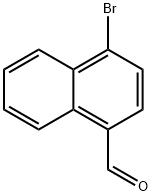
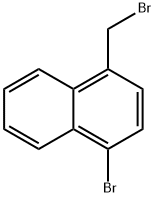
318 g of 1-bromo-4-bromomethylnaphthalene (II), 371.5 g of hexamethylenetetetramine, 795 g of glacial acetic acid, and 795 g of water were added to a 3L three-necked flask and reacted at reflux for 3 h at 100 °C. The reaction process was monitored by thin layer chromatography (TLC). Upon completion of the reaction, 636 g of concentrated hydrochloric acid was rapidly added dropwise for 0.5 hr. After the reaction mixture was cooled to room temperature, 4 L of water was added and stirred continuously for 3 hours. The solid product was collected by filtration, pulped with 2 L of water for 2 hours, filtered again, and the filter cake was washed twice with water, drained, and dried at 40 °C. The dried product was recrystallized with 318 g of ethanol and finally dried to give 200.4 g of 4-bromo-1-naphthaldehyde (III) in 80.4% yield. The molar ratio of 1-bromo-4-bromomethylnaphthalene (II) to hexamethylenetetetramine in the reaction was 1:2.5.
[1] European Journal of Organic Chemistry, 2006, # 10, p. 2329 - 2335
[2] Patent: CN106366018, 2017, A. Location in patent: Paragraph 0040; 0041; 0042; 0043
[3] Inorganic Chemistry, 2016, vol. 55, # 5, p. 1986 - 1991
[4] Chemische Berichte, 1922, vol. 55, p. 1854
[5] Organic Letters, 2008, vol. 10, # 14, p. 3105 - 3108