- Catalyst for the Grignard coupling for regioand stereoselective monoalkylation and arylation of 1,1-dichloro-1-alkenes
- Synthetic pyrethriods: catalyst for the Negishi coupling of (2,2-dihaloethenyl)cyclopropanecarboxylates
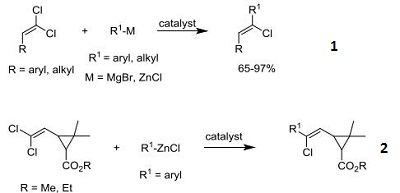
Dichloro[bis(1,4-diphenylphosphino)butane]palladium(II) is used for the catalysis of styrene carbonylation, coupling of alkyl Grignard reagents with organic halides, selective monoalkylation of organic polyhalides, and modification of the dihalovinyl moiety of synthetic pyrethroids.
Dichloro[1,4-bis(diphenylphosphino)butane]palladium(II) (1,4-Bis(diphenylphosphino)butane-palladium(II) chloride) can be prepared conveniently in situ by mixing the bidentate phosphine ligand and
(PhCN)2PdCl2 in either benzene or chloroform.[1] The preparation of (dppb)PdCl2 is also possible through the
reaction of PdCl2 with dppb in acetone, a process that slowly forms the catalyst as a white precipitate which
can be isolated in 51% yield.[2] Preparation of the hydrate complex is possible via the reaction of Na2[PdCl4]
with dppb in a mixture of CH2Cl2 and water.
core: palladium
reaction type: Buchwald-Hartwig Cross Coupling Reaction
reaction type: Cross Couplings
reaction type: Heck Reaction
reaction type: Hiyama Coupling
reaction type: Negishi Coupling
reaction type: Sonogashira Coupling
reaction type: Stille Coupling
reaction type: Suzuki-Miyaura Coupling
reagent type: catalyst
Example 3
Step 1: 10 mL of palladium sponge was mixed with concentrated hydrochloric acid and concentrated nitric acid in a 3:1 volume ratio until the palladium sponge was completely dissolved. 37% concentrated hydrochloric acid was added to the solution and filtered to remove insoluble material while treating the brown nitrogen oxides produced. The filtrate was concentrated to a solution of chloropalladium acid with a palladium concentration of 0.5 g/mL.
Step 2: An N,N-dimethylformamide solution of bis(diphenylphosphino)butane was prepared by adding 44 g of 1,4-bis(diphenylphosphino)butane to 100 mL of N,N-dimethylformamide, and heating to 50°C. The N,N-dimethylformamide solution of bis(diphenylphosphino)butane was then heated to 50°C.
Step 3: The chloropalladium acid solution prepared in step 1 was added dropwise to the bis(diphenylphosphino)butane solution in step 2 under stirring. The reaction was stirred at 50 °C for 60 minutes. After completion of the reaction, the reaction solution was cooled and filtered, and the filter cake was collected.
Step 4: The filter cake obtained in Step III was washed with anhydrous ethanol and then dried under vacuum at 50 °C for 4 h. A light yellow 1,4-bis(diphenylphosphino)butane-palladium(II) chloride complex (C28H28Cl2P2Pd) of 56.1 g was obtained in 98.9% yield.
1. Sugi, Y.; Bando, K.-I. CL 1976, 727.
2. Sanger, A. R. JCS(D) 1977, 1971.






![Dichloro[1,4-bis(diphenylphosphino)butane]palladium(II) pictures](/ProductImageEN/2020-12/Small/f191babb-9e1c-4485-b830-b6c36bfa8aa9.jpg)
