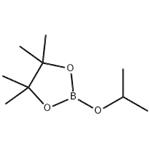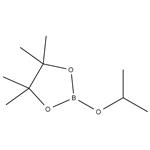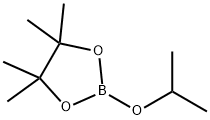
2-Isopropoxy-4,4,5,5-tetramethyl-1,3,2-dioxaborolane
- Product Name2-Isopropoxy-4,4,5,5-tetramethyl-1,3,2-dioxaborolane
- CAS61676-62-8
- MFC9H19BO3
- MW186.06
- EINECS612-189-2
- MOL File61676-62-8.mol
Chemical Properties
| Boiling point | 73 °C15 mm Hg(lit.) |
| Density | 0.912 g/mL at 25 °C(lit.) |
| refractive index | n |
| Flash point | 109 °F |
| storage temp. | Inert atmosphere,2-8°C |
| solubility | Chloroform (Slightly), Methanol (Slightly) |
| form | Liquid |
| Specific Gravity | 0.912 |
| color | Colorless |
| Water Solubility | Soluble in water. |
| Sensitive | Moisture Sensitive |
| BRN | 1906370 |
| InChI | InChI=1S/C9H19BO3/c1-7(2)11-10-12-8(3,4)9(5,6)13-10/h7H,1-6H3 |
| InChIKey | MRWWWZLJWNIEEJ-UHFFFAOYSA-N |
| SMILES | O1C(C)(C)C(C)(C)OB1OC(C)C |
| CAS DataBase Reference | 61676-62-8(CAS DataBase Reference) |
Safety Information
| Hazard Codes | Xi |
| Risk Statements | 10-36/37/38 |
| Safety Statements | 16-26-36 |
| RIDADR | UN 1993 3/PG 3 |
| WGK Germany | 3 |
| HazardClass | 3 |
| PackingGroup | III |
| HS Code | 29209090 |
| Storage Class | 3 - Flammable liquids |
| Hazard Classifications | Eye Irrit. 2 Flam. Liq. 3 Skin Irrit. 2 STOT SE 3 |