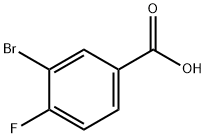
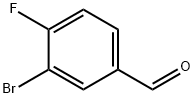
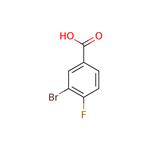
General procedure for the synthesis of 3-bromo-4-fluorobenzoic acid from 3-bromo-4-fluorobenzaldehyde: Sodium chlorite (6.78 g, 75 mmol) and 3-bromo-4-fluorobenzaldehyde (24.63 mmol) were dissolved in a 1:1 mixture of tetrahydrofuran/water solvent (100 mL) and stirred vigorously for 5 hours at 50 °C. After completion of the reaction, ethyl acetate (250 mL) and 1N hydrochloric acid (50 mL) were added to separate the organic and aqueous layers. The organic layer was washed with water (3 x 50 mL) and subsequently extracted with 0.5 M sodium carbonate solution (10 x 50 mL). The basic aqueous layer was combined and acidified by slow addition of concentrated hydrochloric acid under stirring until the carboxylic acid product precipitated. The solid product was collected by filtration and dried under high vacuum overnight to give 4.93 g (91% yield) of 3-bromo-4-fluorobenzoic acid. A portion of the solid carboxylic acid was dissolved in chloroform (30 mL) and concentrated sulfuric acid was added. A reflux condenser was installed and the reaction mixture was heated to 55 °C. Sodium azide (2.36 g, 36.45 mmol) was added in three batches over 1 h. After 4 h, concentrated sulfuric acid (10 mL) and sodium azide (1 g) were made up and stirring was continued at 55 °C for 16 h. The reaction was completed with the addition of sodium azide (1 g). Upon completion of the reaction, the mixture was transferred to a large cooling flask and 5N sodium hydroxide solution was slowly added to neutralize the sulfuric acid. The pH of the solution was adjusted to 8 and the aqueous phase was extracted with dichloromethane (5 x 30 mL). The organic phases were combined, dried with anhydrous sodium sulfate and concentrated in vacuum to give a dark brown oil (2.2 g, 95% yield), which solidified to a solid on standing. The product was characterized by 1H-NMR (CDCl3): δ 6.94 (t, J=8.4 Hz, 1H), 6.88 (dd, J=2.8,5.6 Hz, 1H), 6.58 (m, 1H), 3.62 (s, 2H).