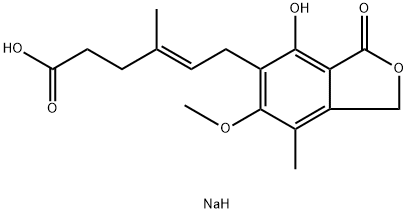
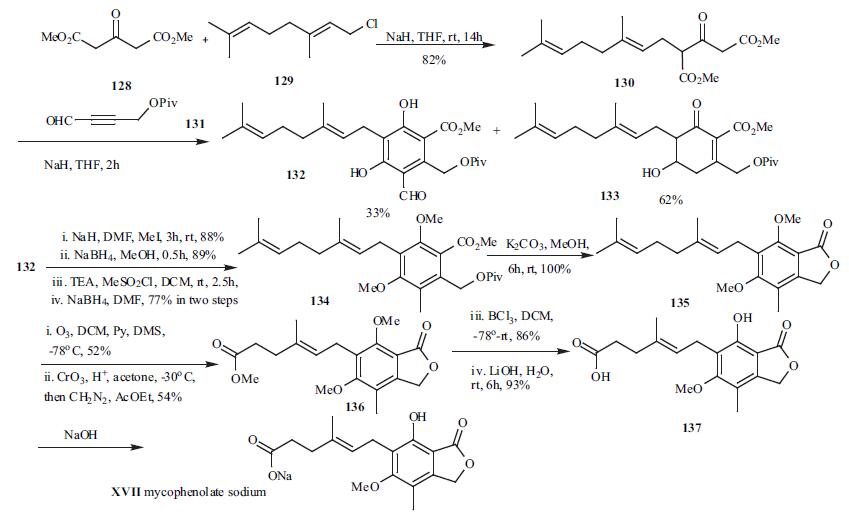
Mycophenolate sodium, an immunosuppressive agent, was launched in
Switzerland as an oral treatment in combination with Neoral and corticosteroids for
the prevention of acute transplant rejection in adult patients receiving allogeneic
renal transplantation. In contrast to the previously marketed product mycophenolate
mofetil (MMF, CellCept), which is a prodrug and must be converted to
mycophenolic acid (MPA) in vivo, Myfortic contains MPA itself as the active
ingredient. Myfortic was designed to enhance the therapeutic efficacy of MPA
through increased tolerability relative to systemic exposure. Unlike MMF, which is
absorbed in the stomach, the enteric-coated formulation of MPA sodium is mainly
absorbed in the small intestine, thus protecting the upper GI tract from the side
effects of MPA. MPA is an inhibitor of inosine monophosphate dehydrogenase
(IMDPH), a vital enzyme in the de novo pathway of purine biosynthesis.
Proliferating lymphocytes rely principally on this pathway for purine production,thus rendering them succeptible to depletion of purine bases by MPA. Inhibition of
IMPDH by MPA results in the inhibition of both T- and B-lymphocyte proliferation
upon antigen challenge and facilitates the prevention of acute graft rejection.
Following oral administration of MPA sodium, the tmax of MPA is 1.5–2 h, with a
mean absolute bioavailability of 71% and a mean half-life of 11.7 h. MPA is
primarily metabolized in the liver by glucuronidation and excreted mainly in the
urine as the metabolite. The recommended dosage regimen of MPA sodium is
720 mg twice daily, which provides equimolar amounts of MPA compared
with MMF 1000 mg twice daily. In two major clinical trials in 748 patients,
Myfortic was demonstrated to be a highly potent and well-tolerated immunosuppressant
for new renal transplant patients. A trend was seen towards fewer dose
reductions due to GI intolerability and less serious infections relative to other MPA
drugs. The most common adverse events associated with MPA treatment are
diarrhea and leukopenia.
ChEBI: An organic sodium salt that is the sodium salt of mycophenolic acid. An immunosuppressant, it is widely used to prevent tissue rejection following organ transplants and for the treatment of certain autoimmune diseases.