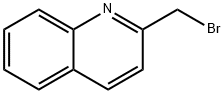
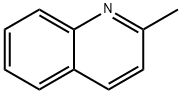
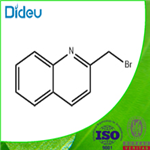
GENERAL METHOD: 2-methylquinoline (0.5 mmol), cuprous halide (0.75 mmol), tert-butyl hydroperoxide (TBHP, 8.0 eq., 70% aqueous solution) and acetonitrile (CH3CN, 2 mL) were added to a reaction flask and the reaction was stirred for 8 hr at 70 °C. After completion of the reaction, the mixture was diluted with water and extracted with dichloromethane (CH2Cl2, 3 x 15 mL). The halogens (X2, X = I, Br, Cl) in the organic phase were quenched with sodium thiosulfate (Na2S2O3) solution. The organic layers were combined, washed with saturated aqueous ammonium chloride (NH4Cl) solution and dried over anhydrous sodium sulfate (Na2SO4). After filtration, the solvent was removed by concentration under reduced pressure. Finally, the target product 2-bromomethylquinoline was purified by silica gel column chromatography (eluent: petroleum ether/ethyl acetate, v/v = 10/1).
[1] Advanced Synthesis and Catalysis, 2018, vol. 360, # 21, p. 4197 - 4204
[2] Tetrahedron, 2018, vol. 74, # 15, p. 1908 - 1917
[3] Tetrahedron Letters, 2014, vol. 55, # 29, p. 3892 - 3895
[4] Chemical and Pharmaceutical Bulletin, 2000, vol. 48, # 4, p. 477 - 479
[5] Journal of Organometallic Chemistry, 2017, vol. 851, p. 194 - 209