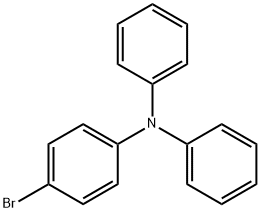
4-Bromotriphenylamine (BTPA) is a bromoaniline compound that can be used as a polymer monomer. Its copolymerisation with p-triphenyl and N-methyl-1-piperidone yields a series of poly(4-bromotriphenylamine-co-p-triphenylpiperidinium) (PBTTP-x) copolymers. The rigid and rotatable BTPA units exhibit a triangular pyramidal geometry, which both generates steric hindrance to suppress polymer chain entanglement and creates additional free volume. Furthermore, the introduction of the BTPA monomer enables efficient ion transport whilst protecting cationic groups from OH− attack via steric hindrance. PBTTP-x copolymers effectively enhance the performance of anion exchange membranes (AEMs)[2].
4-bromotriphenylamine could be used as material to synthesize a novel type of Schiff base fluorescent probe molecule N′-((5-(4-(diphenylamino)phenyl)thiophen-2-yl)methylene)benzenesulfonohydrazide (BS). BS exhibited excellent solvatochromic effect and aggregation-induced emission enhancement and had rapid recognition, high selectivity and specificity for Hg2+; the detection limit was as low as 2.84×10⁸M, and the response time was only 15 s[1].
To a solution of triphenylamine(2.1 g, 8.16 mmol) in 40mL CCl4, NBS (1.6g,8.16 mmol) was added and the reaction mixture refluxed for 4 h under nitrogen (N2) atmosphere. During the reaction, a solid was formed, which conformed as succinimide. After filtering, the reaction mixture, filtrate was evaporated and recrystallized from ethanol to yield 4-Bromotriphenylamine 93%.
[1] Songsong Xue. “Highly Selective and Sensitive Sulfonylhydrazone Type Fluorescent Probe for Rapid Detection of Mercury(II) and Its Application in Logic Gate and Adsorption.” ChemistrySelect 6 28 (2021): 7123–7129.
[2] Sixiang Chen . (2025). Twisted monomer-induced microporous poly(aryl piperidinium) AEMs for high-performance water electrolysis. Polymer, 337, Article 128985. https://doi.org/
10.1016/j.polymer.2025.128985