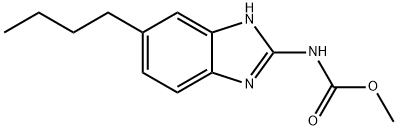
Parbendazole is a carbamate ester-amine. Amines behave as chemical bases. Carbamates are chemically similar to, but more reactive than amides. Like amides they form polymers such as polyurethane resins. Carbamates are incompatible with strong acids and bases, and especially incompatible with strong reducing agents such as hydrides. Flammable gaseous hydrogen is produced by the combination of active metals or nitrides with carbamates. Strongly oxidizing acids, peroxides, and hydroperoxides are incompatible with carbamates.
Including acetylation, nitration, hydrolysis, reduction, ring-forming five reaction steps, p-n-butyl aniline as raw material, first acetylation with acetic anhydride, and then nitration with nitric acid, the product was poured into the ice-water mixture, precipitated solids, pumping filtration, the filter cake washed with water to neutral, drying to get 4-n-butyl-2-nitro acetanilide; and then the dried product was hydrolyzed with potassium hydroxide solution, then adjusted the pH to 6-7 by using 4mol/L~5mol / L hydrochloric acid to adjust the pH to 6 ~ 7, and then concentrated under reduced pressure, the residue will be extracted with ether, collect the organic phase, concentrate to get 4-n-butyl-2-nitroaniline; will be produced 4-n-butyl-2-nitroaniline methanol as a solvent, add palladium carbon as a catalyst, filtration, filtrate concentration to get 4-n-butyl-o-phenylenediamine, and then methanol as a solvent, acetic acid as an amine salt-forming agent, and methyl cyanocarbamate as a ring-closing agent. Then methanol was used as solvent, acetic acid as amine salting agent and methyl cyanocarbamate as ring-closing agent to produce 5-n-butyl-2-benzimidazolecarbamic acid methyl ester (Parbendazole).