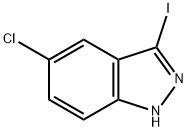
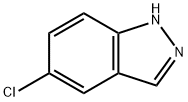
General procedure for the synthesis of 3-iodo-5-chloroindazole from 5-chloro-1H-indazole: the direct iodination reaction was carried out by referring to the method previously reported by Bocchi [28] with slight modifications. The procedure was as follows: 5-chloro-1H-indazole (3 g, 25.4 mmol), iodine (12.7 g, 50.03 mmol) and potassium hydroxide (5.34 g, 95.25 mmol) were dissolved in DMF (7 mL) and the reaction was stirred for 3 h at room temperature. Upon completion of the reaction, the reaction was quenched with saturated sodium bisulfite solution (150 mL), at which time a precipitate was generated. The precipitate was collected by vacuum filtration and washed with water three times (30 mL each). The resulting solid was dried in a vacuum oven at 30 °C overnight to give 6.17 g of the light yellow solid product 3-iodo-5-chloroindazole. Yield: 100%; Melting point: 136-138 °C (literature value:[36] 134-136 °C); IR (KBr) ν (cm^-1): 3086 (NH); 424 (C-I). 1H-NMR δ (ppm): 13.50 (1H, s, H-1); 7.55 (1H, d, J=8.6 Hz, H-7); 7.45- 7.40 (2H, m, H-6 and H-4); 7.19 (1H, dd, J=7.5Hz, H-5).13C-NMR δ (ppm): 140.41; 127.22; 126.79; 121.23; 120.39; 110.51; 93.49. HRMS calculated value C7H4ClIN2: 277.9107 , measured value: 277.9109.