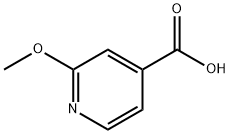
2-Methoxy-4-pyridinecarboxylic acid is often used as an intermediate in pharmaceutical chemistry and organic synthesis. In organic synthesis transformation, the carboxyl group on the pyridine ring can be converted into acyl chloride, ester group and amide under certain reaction conditions without being affected by the pyridine ring, and can also be reduced to a hydroxyl group.
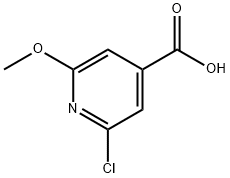
General procedure for the synthesis of 2-methoxy-4-pyridinecarboxylic acid from 2-chloro-6-methoxyisonicotinic acid: To a suspension of acetonitrile (150 mL) containing 2-methoxy-4-pyridinecarboxylic acid (1.94 g, 6.49 mmol) was added sodium iodide (4.90 g, 32.69 mmol) and trimethylmethylsilyl chloride (4.10 mL, 32.42 mmol). The reaction mixture was stirred at 40 °C for 3 days under nitrogen protection. After completion of the reaction, the mixture was cooled to 0 °C, the solid product was collected by filtration, washed with acetonitrile and dried to afford 1.66 g (90% yield) of the target compound, 2-methoxy-4-pyridinecarboxylic acid.LRMS: m/z 285 (M + 1)+; retention time: 2.86 min (Method B).
[1] Patent: WO2010/43377, 2010, A1. Location in patent: Page/Page column 64
[2] Yakugaku Zasshi, 1953, vol. 73, p. 845,846, 847
[3] Chem.Abstr., 1954, p. 10021