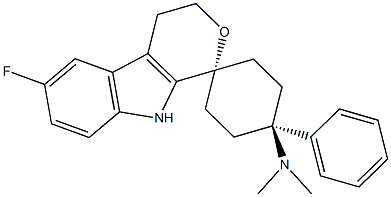
Cebranopadol exhibits highly potent and efficacious antinociceptive and antihypersensitive effects in several rat models of acute and chronic pain (tail-flick, rheumatoid arthritis, bone cancer, spinal nerve ligation, diabetic neuropathy) with ED50 values of 0.5-5.6 μg/kg after intravenous and 25.1 μg/kg after oral administration. In comparison with selective MOP receptor agonists, cebranopadol is more potent in models of chronic neuropathic than acute nociceptive pain. Cebranopadol’s duration of action is long (up to 7 hours after intravenous 12 μg/kg; >9 hours after oral 55 μg/kg in the rat tail-flick test). The antihypersensitive activity of cebranopadol in the spinal nerve ligation model is partially reversed by pretreatment with the selective NOP receptor antagonist J-113397 or the opioid receptor antagonist naloxone, indicating that both NOP and opioid receptor agonism are involved in this activity[1].